Sauna vs steam room
Dry heat at 190 °F against wet heat at 110 °F. They feel completely different, and one of them is far harder to put in a house.
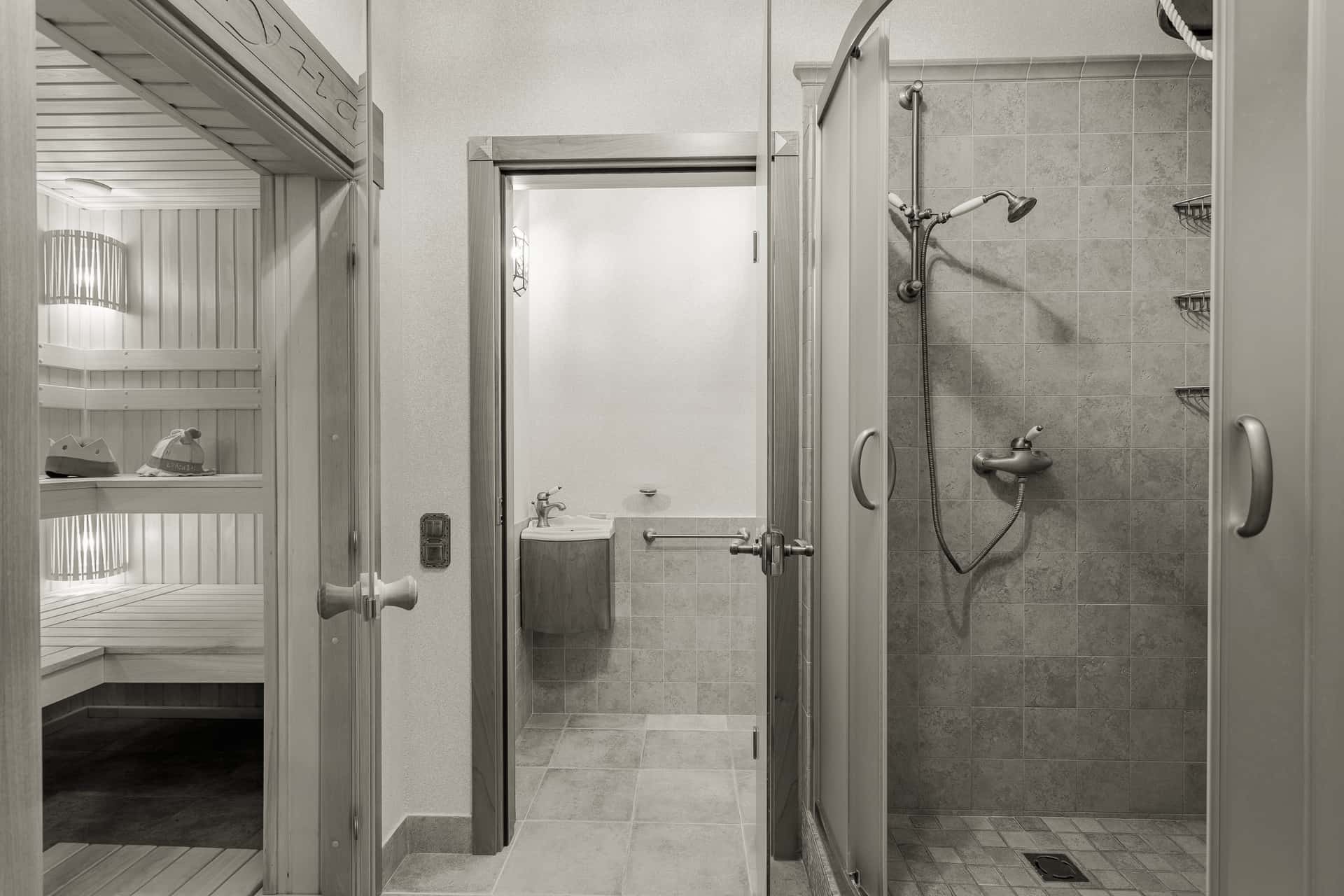
The short verdict: for a home, a sauna is far easier to install, far easier to maintain, and easier to live with. A steam room is a genuinely different and pleasant experience, and it is a wet room in your house that has to be waterproofed like one. If you are choosing between them for a home installation, the practical answer is usually the sauna.
| Sauna (traditional) | Steam room | |
|---|---|---|
| Temperature | 175–195 °F | Around 110–120 °F |
| Humidity | Low, or your choice | 100% — saturated |
| How it feels | Dry, intense, heat on the skin | Wet, enveloping, heavy air |
| Materials | Timber | Tile, sealed panels — nothing porous |
| Construction | Insulated timber room | Fully waterproofed wet room |
| Drainage | Not required | Required |
| Maintenance | Wipe down, air out | Mold and scale management, continuous |
| Can you throw water? | Yes — that is the point | Not applicable, it is already saturated |
Why the temperature difference is the whole experience
A steam room is cooler than a sauna by a wide margin and often feels hotter. That is not a contradiction — it is what saturated air does. In dry heat your sweat evaporates and cools you. In 100% humidity it cannot evaporate at all, so the cooling mechanism your body is relying on simply stops working.
The result is that 115 °F saturated air feels considerably more oppressive than 190 °F dry air, and sessions are typically shorter. People who love one often dislike the other, and the split is genuine rather than a matter of tolerance.
The installation gap is enormous
This is what decides the question for most homes, and it is much bigger than the price difference suggests.
- A sauna is an insulated timber room. It needs a vapor barrier, ventilation and a 240 V circuit for the heater. Water on the floor is incidental.
- A steam room is a wet room. Every surface must be non-porous and fully waterproofed — tile or sealed panels, a sealed ceiling sloped so condensate runs to the walls rather than dripping on you, and a floor drain. It also needs a steam generator, usually sited outside the room, plumbed and wired.
A failure in a sauna's construction means it does not get hot enough. A failure in a steam room's waterproofing means water in your building fabric — which is a far more expensive kind of wrong.
Maintenance is the other gap
The middle option nobody mentions
A traditional sauna is not necessarily dry. Throwing water on the stones produces loyly — a burst of humid heat — and doing it repeatedly gives you a genuinely humid sauna, well short of a steam room's saturation but a long way from bone-dry.
If what appeals about a steam room is the humidity rather than the specific 100%-saturated experience, a traditional sauna with a good stone mass gets you a meaningful way there without a wet room. That is the honest compromise and it is why we would steer most people towards a sauna with a larger-stone heater rather than towards a steam installation.
What about infrared?
Infrared is the third option and it is drier and cooler than either — 120–150 °F, radiant heat, no humidity control at all. It is by far the easiest to install: no wet room, no 240 V circuit in most cases, no drainage. See infrared vs traditional and, for the plain-language version, sauna vs infrared sauna.
Ranked by installation difficulty: infrared cabin, then traditional sauna, then steam room, and the gaps between them are large.
What the research covers
Worth being precise about, because marketing for both borrows freely from the other. The substantial observational literature on habitual heat exposure comes from Finnish sauna cohorts — dry sauna use — including the JAMA Internal Medicine analysis linked below. That is sauna research and it does not automatically transfer to steam rooms, which are a different temperature, humidity and session length.
We keep the claims where the research is. See sauna benefits and the evidence.
Which should you build?
A sauna, for almost every home installation. Simpler construction, no waterproofing risk, dramatically less maintenance, and you can add humidity when you want it.
A steam room, if you specifically love the saturated-air experience, are already renovating a bathroom to a wet-room standard, and are realistic about descaling. It is a legitimate choice — it is just a bigger project than people expect and it stays a bigger commitment afterwards.
Saunas, if that is the side you landed on
Canadian Red Cedar 2-Person Traditional Sauna, 6 kW Harvia
MCP Distributions
#ad Price as of October 23, 2026. We earn a commission if you buy, at no extra cost to you. How this is funded.
A real Harvia heater inside a cedar room, sold as one box. If you have been running an infrared cabin and want actual loyly, this is the shortest path to it.
| Capacity | 2 person |
|---|---|
| Type | Traditional, wet or dry |
| Wood | Canadian red cedar |
| Heater | 6 kW Harvia |
| Circuit | 240 V — required for a 6 kW heater |
| Extras | Built-in sound system |
| Stones | Included |
What works
- Harvia is a heater brand with a published spec sheet and a real parts supply
- Cedar rather than hemlock — better rot resistance where humidity is high
- Wet or dry, so you can actually throw water
What doesn't
- 6 kW needs a dedicated 240 V circuit and a permit in most places
- Cedar costs more and the price reflects it
- A two-person footprint with a stove in it is tight
Skip it ifyou cannot run 240 V. Every traditional heater above roughly 4.5 kW needs it, and there is no workaround worth attempting.
Dynamic Lugano 3-Person Far Infrared Sauna
Dynamic Saunas
#ad Price as of October 23, 2026. We earn a commission if you buy, at no extra cost to you. How this is funded.
One of the few cabins in this price class that puts an EMF number in the listing rather than the word 'low' on its own — which is the only reason it can be ranked against anything.
| Capacity | 3 person |
|---|---|
| Wood | Canadian hemlock |
| Heater type | Carbon far-infrared panels |
| EMF, as published | Under 8 mG |
| Measurement distance | Not published |
| Spectrum | Far infrared only |
| Power draw | Not published in the listing |
What works
- Publishes an actual EMF figure instead of the unqualified word 'low'
- Hemlock rather than a softwood that resins at temperature
- Three-person footprint without the premium-tier price
What doesn't
- The EMF figure has no stated measurement distance, so it cannot be compared like for like
- Far infrared only — no near or mid wavelengths
- Assembly is genuinely a two-person job
Skip it ifyou want full-spectrum output. This is a far-infrared cabin and no amount of marketing language changes that — if near infrared matters to you, you are shopping in a different tier.
Northern Lights DIY Sauna Kit, 4' × 6', 5 kW Heater
Northern Lights Group
#ad We earn a commission if you buy, at no extra cost to you. How this is funded.
A room package rather than a building. If you already have a spare closet, basement corner or garage bay, this is the cheapest route to a real traditional sauna.
| Format | DIY room kit |
|---|---|
| Size | 4 ft × 6 ft |
| Heater | 5 kW electric |
| Wood | Clear kiln-dried western red cedar |
| Door | Insulated cedar with tempered glass |
| Hardware | Brass door hardware included |
| Circuit | 240 V |
What works
- Clear, knot-free kiln-dried cedar is a genuinely higher grade than 'rustic'
- Uses space you already have a roof over and already heat
- Insulated door included — the part people cheap out on
What doesn't
- You supply the framing, insulation, vapor barrier and the electrical work
- 5 kW into 24 square feet is on the strong side, so watch the controller
- No shell — this is not a standalone building
Skip it ifyou do not already have a suitable space. A kit with nowhere to go is a pile of cedar.
Questions people actually ask
What is the difference between a sauna and a steam room?
Is a steam room hotter than a sauna?
Which is easier to install at home, a sauna or a steam room?
Is a steam room high maintenance?
Can you get humidity in a sauna?
Sources
Read next
- Infrared vs traditional saunaThe third option, and the easiest to install.Read it
- Best sauna kitsConverting a room you already have.Read it
- Sauna benefits and the evidenceWhat the research actually covers.Read it
- Sauna vs hot tubThe other comparison people make.Read it
- Best steam saunas for homeIf steam is the answer you landed on.Read it
- Best indoor traditional saunasBuying the traditional side.Read it
- SAUNABOX reviewA portable steam room.Read it
- Sauna vs steam showerWhat each one demands of the building.Read it
- Dry sauna vs wet saunaThe same room, run two ways.Read it
Every pick on this page comes from published specifications, not from hardware we own. Read how we pick — including what spec-led ranking cannot tell you.