Sauna vs steam shower
A steam shower converts a room you already have. A sauna adds one. That single difference decides most of this, and the rest comes down to a sizing calculation that punishes marble and rewards low ceilings.
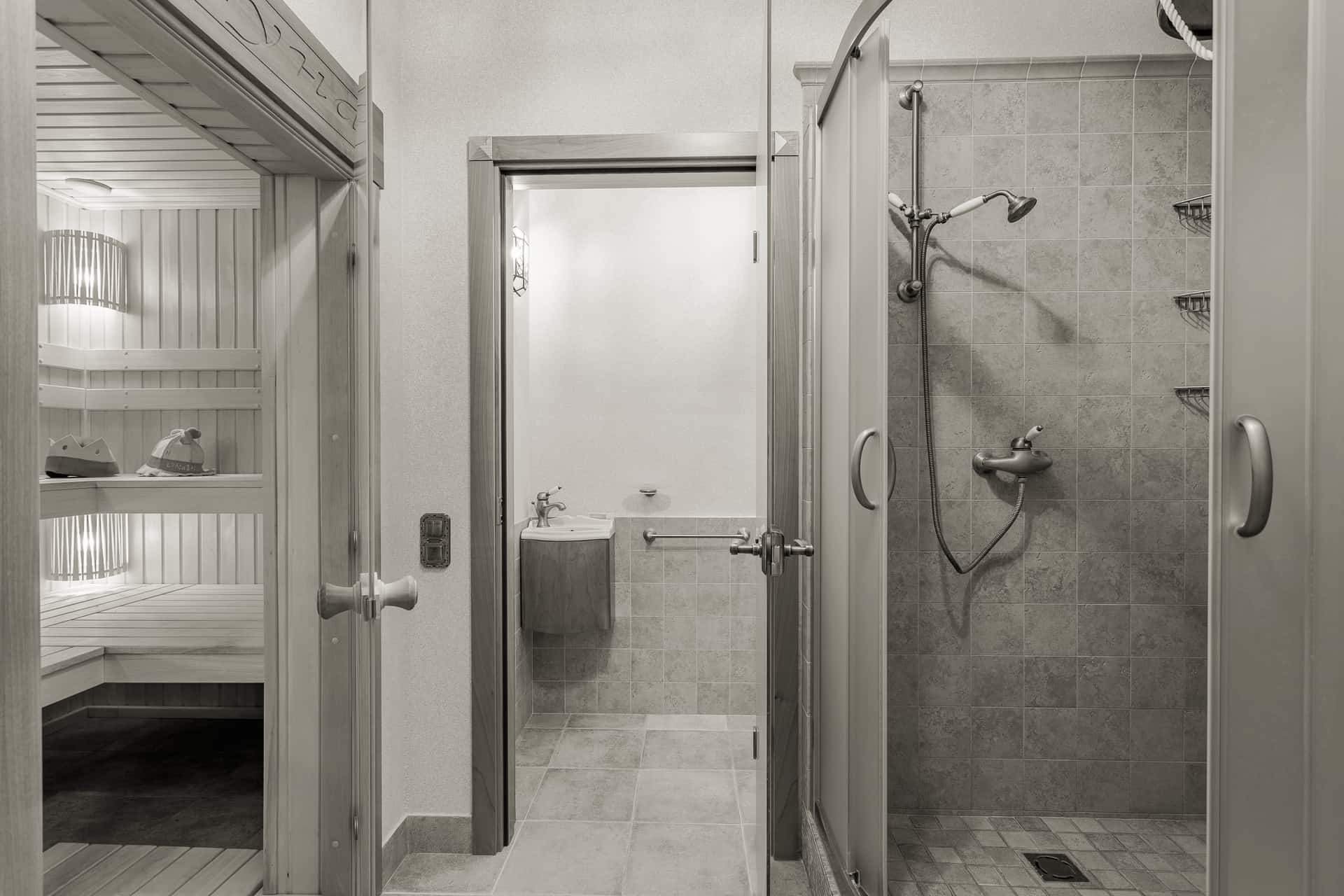
The short version: a steam shower is a sealed, tiled enclosure with a generator plumbed and wired to it, running around 110 to 120 °F at fully saturated humidity. A sauna is a wood-lined room with a stove and stones, running 158 to 194 °F at low humidity with bursts of steam. The steam shower usually costs less because the enclosure already exists — you are converting a shower. The sauna usually costs more because you are building a room. Everything else follows from that.
What each one actually is
| Steam shower | Traditional sauna | |
|---|---|---|
| Temperature | About 110–120 °F | 158–194 °F typical Finnish range |
| Humidity | Fully saturated | Low, with löyly bursts |
| Heat source | Steam generator, plumbed and hardwired | Electric or wood stove with stones |
| Enclosure | Sealed, tiled or stone, sloped ceiling, vapor tight | Wood-lined, insulated, foil vapor barrier, vented |
| Drain | Required — it is a shower | Not required; water evaporates |
| Circuit | 208 or 240 V, generator sized by volume | 240 V, heater sized by volume |
| Session feel | Oppressive sooner; sweat cannot evaporate | Dry heat, longer sessions, sharper löyly spikes |
Temperature ranges from our sauna temperature guide and from published steam-generator guidance, read on 2026-09-23.
The reason a steam room at 115 °F can feel harder than a sauna at 190 °F is evaporation: in saturated air your sweat cannot evaporate, and evaporation is how your body sheds heat. That is also why steam sessions are shorter. Our sauna vs steam room page covers the physiology side of that comparison; this page is about what each one does to your house.
Sizing a steam generator, which is where projects go wrong
A steam generator is not sized by the square footage of the shower floor. It is sized by the enclosure's volume, adjusted for how quickly the surfaces bleed heat. Steamist's published method is the clearest version of the standard approach: multiply length by width by height in feet, then apply multipliers — natural stone or marble doubles the figure, ceramic or porcelain tile and glass block multiply it by 1.35, one exterior wall adds 10 percent and two add 20 percent, a 9-foot ceiling adds 15 percent and a 10-foot ceiling adds 30 percent.
| Adjusted volume | Generator |
|---|---|
| 101–250 cu ft | 7.5 kW |
| 251–450 cu ft | 10 kW |
| 451–550 cu ft | 12 kW |
| 551–675 cu ft | 15 kW |
From Steamist's published sizing guide, read on 2026-09-23. It also states that ceiling height should not exceed 8 feet, with 10 feet the maximum, that a skylight or outside window means stepping up a size, and that generator voltage must match the local supply at 208 or 240 V.
Run that on a real bathroom and the numbers move fast. A 4 × 5 shower with an 8-foot ceiling is 160 cubic feet. Tile it and you are at 216. Put it on an outside wall and you are at 238 — still a 7.5 kW generator. Do the same room in marble and you are at 320 before the exterior wall, which is a 10 kW generator and a different circuit. That multiplier is the single most expensive decision in a steam project, and it is made by whoever picks the tile.
Sizing a sauna heater, for comparison
Sauna heaters are rated the same way — by room volume — but without the material multipliers, because the room is wood over insulation rather than stone over cement board. Harvia publishes 106 to 212 cubic feet for 4.5 kW, 177 to 283 for 6 kW, 251 to 424 for 8 kW and 283 to 494 for 9 kW. A 5 × 6 sauna with a 7-foot ceiling is 210 cubic feet, so a 6 kW heater on a 240 V circuit. Our sauna heater sizing guide covers the details, including why ceiling height above 7 feet hurts a sauna more than it helps.
What each one demands of the building
- A steam shower needs a vapor-tight enclosure — a sloped ceiling so condensate runs off rather than dripping, a door that seals, and waterproofing behind the tile. A conventional shower converted badly will push moisture into the framing.
- A sauna needs insulation, a foil vapor barrier and two vents, high and low. Finlandia's contractor sheet specifies R13 batts, type C building foil over the insulation on all walls and ceiling, and two 4 × 10-inch louvered vents.
- A steam shower needs a drain and a water supply. A sauna needs neither — the water from löyly evaporates, and a drain is a convenience rather than a requirement.
- Ceiling height cuts opposite ways. Steam wants no more than 8 feet; a sauna wants 7 feet and starts heating poorly above 8.
- Both need a dedicated circuit at 208 or 240 V, sized to the appliance.
Which one to build
Build a steam shower if you have a shower worth converting, you want the thing to disappear into an existing bathroom, and you would rather have 15 minutes of saturated heat than 25 minutes of dry heat. Build a sauna if you have a garage bay, a basement corner or a backyard pad, you want longer sessions, and the löyly cycle is the part you actually want — no steam shower reproduces water on hot stones. Our best saunas for basements and best saunas for garages pages cover the siting, and best steam saunas for home covers the generator-plus-enclosure route in more depth.
The budget version of each
You can test both ideas cheaply before committing. A portable steam tent with its own steamer gives you saturated heat in a corner of a room for the price of a nice dinner; a sauna blanket gives you dry radiant heat with no installation at all. Neither is the real thing — the tent has no thermal mass and the blanket has no air to breathe — but both answer the question of which kind of heat you actually enjoy. See best portable steam saunas and best sauna blankets.
Generators and a heater to compare
SteamSpa Sentry 9 kW Steam Generator, 240 V
SteamSpa
#ad Price as of Sep 27, 2026. We earn a commission if you buy, at no extra cost to you. How this is funded.
Auto drain is the specification that decides how long a steam generator lasts — scale is what kills them, and a unit that empties itself after every session is not sitting full of it.
| Output | 9 kW |
|---|---|
| Voltage | 240 V |
| Time to steam | 1–2 minutes |
| Drain | Built-in automatic |
| Material | Stainless steel |
| Weight | 28.8 pounds |
| Dimensions | 20" × 10" × 20" |
| Included | Control panel, steamhead, pressure relief valve |
What works
- Automatic drain directly addresses the failure mode that ends steam generators
- 1–2 minutes to steam is genuinely fast against a sauna's 30–45 minute warm-up
- Control panel, steamhead and relief valve in the box rather than as extras
What doesn't
- 240 V and a real plumbing connection — this is an installation, not an appliance
- No published rated room volume, so sizing is left to you
- Hard water will still need periodic attention despite the auto drain
Skip it ifyou do not already have an enclosed, sealed and tiled space to put steam into. The generator is the cheap part of a steam room.
CGOLDENWALL 6 kW Self-Draining Steam Generator
CGOLDENWALL
#ad Price as of Sep 27, 2026. We earn a commission if you buy, at no extra cost to you. How this is funded.
6 kW is the right size for a domestic shower enclosure, and this publishes both its temperature band and its run-time band rather than one or neither.
| Output | 6 kW |
|---|---|
| Temperature range | 95–131 °F |
| Run time | 30 minutes to 12 hours |
| Drain | Self draining |
| Tank | Stainless steel |
| Installation | Compact — vanity or closet |
| Rated room volume | Not published |
What works
- Sized for a real domestic shower rather than a commercial suite
- Both temperature and run-time ranges published
- Stainless tank and self-draining, which is the durable combination
What doesn't
- No published rated room volume, so you are sizing on kW alone
- A 95 °F floor means it will not run gently
- Commercial framing on a unit most people will fit at home
Skip it ifyour enclosure is large or poorly sealed. 6 kW into a leaky room is a generator that runs forever and never reaches temperature.
Kooby 4 kW Self-Draining Steam Generator with Aroma Port
Kooby
#ad Price as of Sep 27, 2026. We earn a commission if you buy, at no extra cost to you. How this is funded.
4 kW is the entry point at which a steam installation still works, and the automatic drain-cleaning cycle is a maintenance feature the bigger units charge more for.
| Output | 4 kW |
|---|---|
| Voltage | 220 V |
| Time to steam | 2–4 minutes |
| Drain | Automatic drainage and cleaning system with access port |
| Control | Waterproof touch panel |
| Extras | Aroma port |
| Rated room volume | Not published |
What works
- An automatic cleaning cycle as well as an automatic drain
- Sectional heating for more even output at low power
- Complete kit rather than a generator plus a shopping list
What doesn't
- 4 kW limits you to a genuinely small, well-sealed enclosure
- No rated room volume published
- Aroma ports are pleasant and are not a therapeutic feature
Skip it ifyour enclosure is a full bathroom rather than a shower cubicle. 4 kW will not fill a room that size with steam.
VEVOR 9 kW Steam Generator with Digital Controller
VEVOR
#ad Price as of Sep 27, 2026. We earn a commission if you buy, at no extra cost to you. How this is funded.
The only steam generator in this survey that publishes the room volume it is rated for, which turns sizing from guesswork into arithmetic.
| Output | 9 kW |
|---|---|
| Rated room volume | 212–318 cu ft (6–9 m³) |
| Temperature range | 77–131 °F (25–55 °C) |
| Time to steam | Under 5 minutes |
| Run time | 10 minutes to 24 hours |
| Drain | Automatic |
| Control | Digital, with real-time indicators |
What works
- Publishes a rated room volume — the single most useful spec here and almost unique
- A full temperature range with both ends stated
- Compact enough to install under a bench or in a vanity
What doesn't
- Under 5 minutes to steam is slower than the SteamSpa units claim
- 131 °F is a modest ceiling for a steam room
- No published water hardness guidance, which matters more than most buyers realize
Skip it ifyour steam enclosure is larger than 318 cubic feet. Undersizing a generator means it runs continuously and never quite gets there.
Harvia KIP 6 kW Sauna Heater with Built-In Controls
Harvia
#ad Price as of Sep 27, 2026. We earn a commission if you buy, at no extra cost to you. How this is funded.
The KIP's larger stone chamber is the reason to choose it over the Topclass: more stone mass means better heat retention and a softer steam when you throw water.
| Output | 6 kW |
|---|---|
| Rated room volume | 177–283 cubic feet |
| Voltage | 240 V, single phase |
| Controls | Built in |
| Stone space | Larger than the Topclass |
| Casing | Low outer surface temperature |
What works
- More stone mass gives a gentler, wetter loyly
- Low outer casing temperature is a genuine safety feature in a small room
- Same published volume-rating discipline as the rest of the Harvia line
What doesn't
- Built-in controls put the dial inside the hot room
- More stones is more weight on the wall bracket
- Slightly longer initial warm-up than a low-mass heater
Skip it ifyou want to preheat from indoors on a timer. Built-in controls put every adjustment inside the sauna.
Specs above are the manufacturer's published figures — source.
Four steam generators across the output range, and a traditional sauna heater at the equivalent size, so you can see what each side of this decision costs in equipment before tile and carpentry.
Questions people actually ask
Is a steam shower cheaper than a sauna?
How do you size a steam generator?
Does a steam shower need a drain?
Can you put a sauna in a bathroom?
Which is better for recovery, steam or sauna?
Sources
- Steamist — steam generator sizing guide (volume method, material multipliers, kW by cubic feet) — checked Sep 23, 2026
- Harvia — KIP60 heater, rated room volume — checked Sep 23, 2026
- Harvia — Vega BC45 heater, rated room volume — checked Sep 23, 2026
- Finlandia Sauna — specifications for contractors (insulation, vapor barrier, ventilation) — checked Sep 23, 2026
- InfoFinland — Finnish sauna temperature range — checked Sep 23, 2026
Read next
- Sauna vs steam roomThe physiology comparison.Read it
- Best steam saunas for homeGenerators and enclosures.Read it
- Sauna heater sizing guideThe sauna side of the arithmetic.Read it
- Best portable steam saunasTesting the idea cheaply.Read it
- Best saunas for basementsWhere a sauna usually goes.Read it
- Finnish sauna guideWhy löyly has no steam-shower equivalent.Read it
Every pick on this page comes from published specifications, not from hardware we own. Read how we pick — including what spec-led ranking cannot tell you.