Sauna temperature guide
Traditional, infrared and steam run at very different temperatures and feel more different still — because humidity, not the number, decides how heat lands on you.
The operating ranges
| Type | Air temperature | Humidity | How it feels |
|---|---|---|---|
| Traditional, dry | 175–195 °F | Low | Intense dry heat; heat on the skin and in the breath |
| Traditional, with loyly | 175–195 °F | Spikes when you throw water | Sharp bursts of much more intense heat |
| Infrared cabin | 120–150 °F | Ambient | Radiant warmth on whatever faces a panel; easy air |
| Steam room | 110–120 °F | 100% | Heavy, enveloping; cooling stops working |
The steam room row is the one that surprises people: the coolest air temperature in the table and frequently the one people tolerate for the shortest time.
Why humidity changes the number's meaning
Your body's main cooling mechanism in heat is evaporating sweat. That works well in dry air and progressively worse as humidity rises. In fully saturated air it does not work at all.
This is why 190 °F dry air is tolerable for 15 minutes and 115 °F saturated air often is not. It is also why throwing water in a traditional sauna makes it feel dramatically hotter without the thermometer moving much — you have not raised the temperature meaningfully, you have interrupted your cooling.
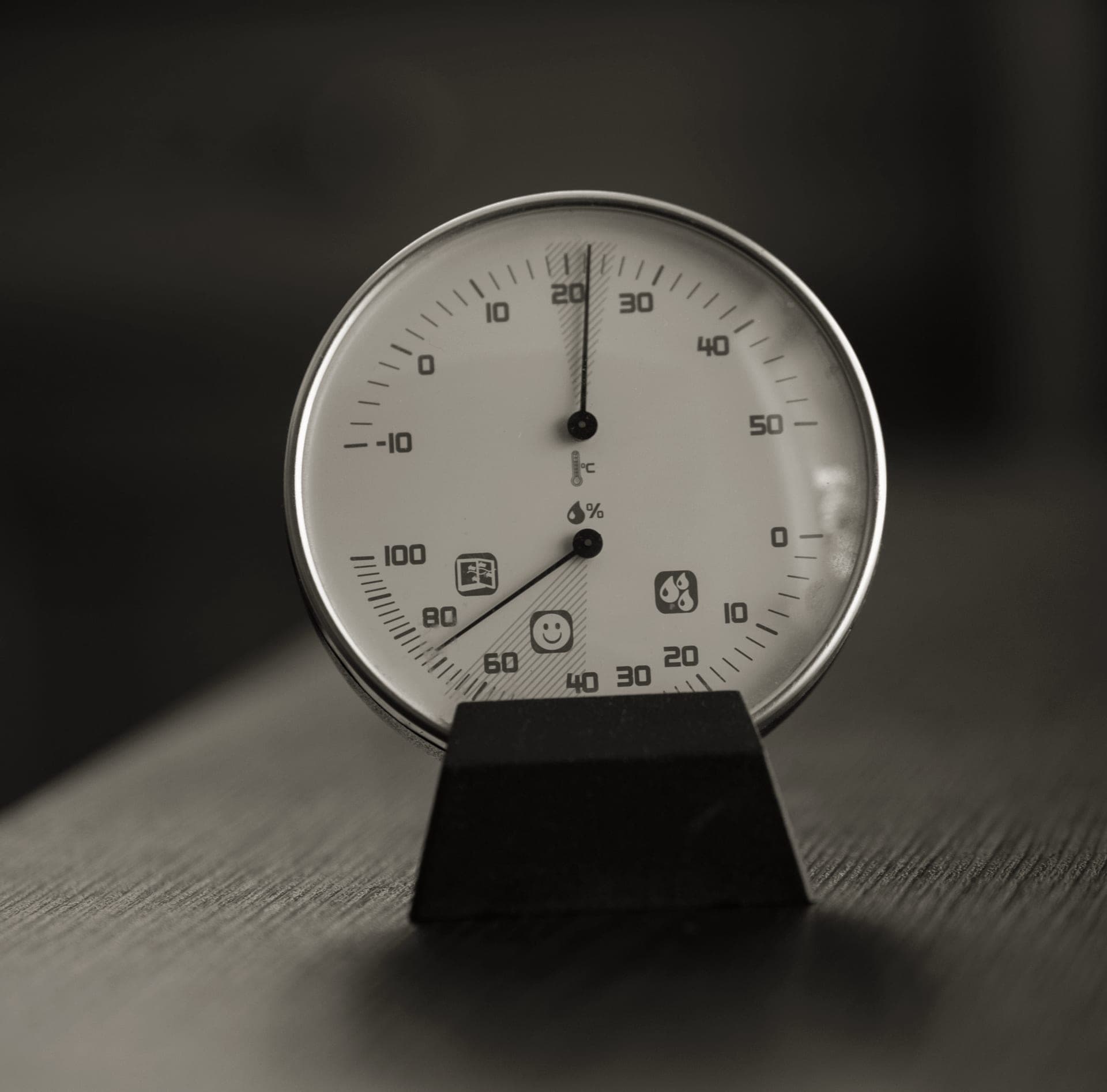
The practical implication: a sauna thermometer tells you less than you think on its own. A hygrometer alongside it is what makes the reading interpretable, which is why sauna gauges are usually 2-in-1. See best sauna thermometers.
Where in the range should you sit?
Literally as well as figuratively — heat stratifies sharply in a sauna, and the difference between the lower and upper bench can be substantial. Sitting lower is a legitimate way to have a gentler session without changing the thermostat, and it is what people new to it should do.
On the thermostat itself: the ranges above are what the equipment is designed around, and there is no single correct number inside them. Start at the lower end, see how you find it, and adjust. Heat tolerance is individual and builds with regular exposure.
Getting the room to temperature
- 1Expect 30–45 minutes from cold for either infrared or traditional. Nobody publishes a figure and this is what owner reports and the physics both point to.
- 2Longer in an unheated space. A garage or an outdoor barrel in January takes considerably longer.
- 3Correct heater sizing matters more than the thermostat setting. An undersized heater never reaches the top of its range regardless of what you set. See heater sizing.
- 4Scheduled preheat is worth more than it looks. A 30–45 minute wait is what turns a spontaneous session into a plan, and a cabin you actually use beats a technically better one you do not.
Session length
We are not going to prescribe one. What we can say is what the equipment and general safety guidance point at: traditional sauna sessions are typically shorter than infrared sessions, because the air temperature is far higher — 10 to 20 minutes is the commonly cited range for traditional, and infrared sessions run longer because 130 °F is simply easier to sit in.
Multiple shorter rounds with cooling breaks between them is the traditional Finnish pattern and it is more comfortable than one long session. If you are adding cold to that, see contrast therapy.
The safety points
- Hydrate before and after. You lose fluid through sweat and you will not notice how much.
- No alcohol. It impairs thermoregulation and judgment in an environment where both matter.
- Get out if you feel unwell. Dizziness, nausea or confusion are reasons to leave immediately rather than to push through.
- Do not sauna alone if you are new to it, and especially not if you have any relevant medical condition.
- Cool down gradually rather than going straight from 190 °F to a cold shower if you are not used to it.
- Medical conditions change this entirely. Heart conditions, blood pressure, pregnancy and some medications all matter. Ask a doctor.
Why infrared cabins run cooler
Not because they are weaker, but because they work differently. An infrared cabin heats you by radiation rather than heating the air and letting the air heat you. So the air temperature can be much lower while you still sweat.
That is why comparing 130 °F infrared to 190 °F traditional as though they were the same measurement is misleading — they are two different mechanisms producing a similar outcome by different routes. The full comparison is in infrared vs traditional.
Questions people actually ask
What temperature should a sauna be?
Why does a steam room feel hotter than a sauna?
How long does a sauna take to heat up?
How long should you stay in a sauna?
Is a hotter sauna better?
Sources
Read next
- Best sauna thermometersMeasuring it, and mounting position.Read it
- Sauna benefits and the evidenceWhat the research covers.Read it
- Contrast therapy guideAdding cold to the session.Read it
- Infrared vs traditional saunaWhy the numbers are not comparable.Read it
- Best sauna timersKeeping track of time.Read it
- Finnish sauna guideLöyly, and why the dial is not the point.Read it
- How often should you use a saunaFrequency, from the same research.Read it
Every pick on this page comes from published specifications, not from hardware we own. Read how we pick — including what spec-led ranking cannot tell you.