The best chillers for a bathtub
Using the bath you already own is the cheapest route into cold plunging. Here is which chillers actually work with it, and the three practical problems nobody mentions.
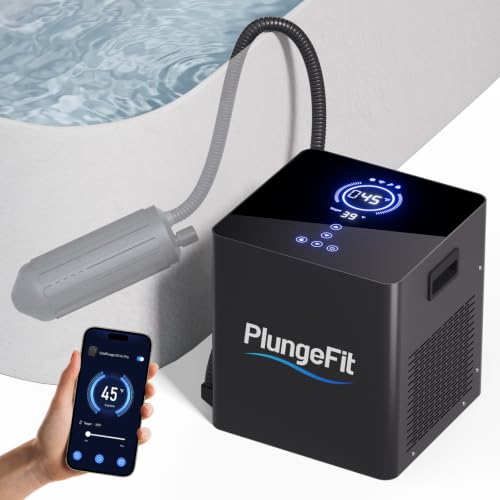
A standard bathtub holds somewhere around 40 to 60 gallons at plunging depth, it is already plumbed, and it costs nothing extra. On paper it is the obvious way to start cold plunging without buying a tub at all.
In practice there are three problems, and they are worth understanding before you buy a chiller rather than after.
The three catches
- 1Bathtubs are uninsulated and sit in a heated house. Porcelain or acrylic over air, in a room at 68 °F, is close to the worst thermal case for holding cold water. The chiller will cycle far more than it would on an insulated tub in a garage.
- 2You also bathe in it. Draining and refilling for each use throws away water the chiller already cooled, which is the entire point of a chiller. Leaving it full of cold water means the bath is unavailable.
- 3Chemistry and hygiene. A body of water sitting for days needs filtration and sanitation. In a bathroom that means a filter loop and probably ozone, running in a room you also use.
None of these makes it a bad idea. They do mean the bathtub route suits a specific situation — a second bathroom, or a household happy to give a tub over to plunging — rather than being a universal shortcut.
Quick picks
| # | Product | Best for | Key spec | Price |
|---|---|---|---|---|
| 1 | Cold Plunge Chiller Pro, 1/2 HP Drop-InDrop-in means the cooling element goes into the water and there is nothing to plumb. If you have ever fought a hose clamp at 6 a.m., that is worth real money. | No plumbing at all | 1/2 HP drop-in, 39 °F, zero install | $549.00 · View on Amazon $599.00 · 8% off |
| 2 | AS ColdPlunge 1/3 HP Chiller, Built-In Filter and PumpThe integrated pump and filter is the reason to pick this one: an external-pump chiller needs three more purchases and four more hose connections to reach the same place. | The overall chiller pick | 1/3 HP, cools to 42 °F, pump and filter built in | |
| 3 | 1 HP Cold Plunge Chiller with External Pump and FiltrationAn external pump is a part you can replace in ten minutes without opening the chiller. On a device that runs continuously, that is a feature rather than a compromise. | Serviceable plumbing | 1 HP on 110 V, external pump | |
| 4 | Healcryo 1.5 HP Cold Plunge Chiller, 12,000 BTU/h, Heat and Cool12,000 BTU/h is the number to look for if your tub lives outside in a hot climate — the smaller units simply cannot outrun a 95 degrees F afternoon. It is also the only chiller in this survey that publishes a noise figure, which in this category is close to unheard of. | Large tubs and hot climates | 1.5 HP / 12,000 BTU/h, titanium heat exchanger, ozone, 35–55 dB, IPX4, 110 V |
#ad Amazon links are affiliate links. Tap any row to jump to that product's full write-up. Prices are Amazon's own, as of October 23, 2026; confirm the current price on Amazon.
How we picked
Explicit bathtub compatibility first, since not every chiller states it. Installation type second — a drop-in needs no plumbing at all, which in a bathroom is a very large practical advantage. Capacity third, and here smaller is genuinely fine: a bathtub's 40–60 gallons is well within a 1/3 HP unit's range even accounting for the poor insulation.
The picks in full
Cold Plunge Chiller Pro, 1/2 HP Drop-In
Cold Plunge Chiller Pro
$599.00 · 8% off
#ad Price as of October 23, 2026. We earn a commission if you buy, at no extra cost to you. How this is funded.
Drop-in means the cooling element goes into the water and there is nothing to plumb. If you have ever fought a hose clamp at 6 a.m., that is worth real money.
| Cooling capacity | 1/2 HP |
|---|---|
| Minimum temperature | 39 °F |
| Installation | Drop-in — no plumbing |
| Control | Wi-Fi app and touchscreen |
| Voltage | 110 V |
| Fits | Any tub |
| Filtration | None — chilling only |
What works
- No hoses, no clamps, no leak points — that failure mode simply is not there
- 1/2 HP pulls down meaningfully faster than the common 1/3 HP units
- A 39 °F floor, three degrees below the 1/3 HP class
What doesn't
- The cooling element occupies tub space you would rather sit in
- Drop-in units do not filter — you still need a separate filter loop
- Wi-Fi control means an app account for a device that wants a dial
Skip it ifyou want sanitation handled in the same box. A drop-in chills and nothing else, so budget for a filter and an ozone loop separately.
AS ColdPlunge 1/3 HP Chiller, Built-In Filter and Pump
AS ColdPlunge
#ad Price as of October 23, 2026. We earn a commission if you buy, at no extra cost to you. How this is funded.
The integrated pump and filter is the reason to pick this one: an external-pump chiller needs three more purchases and four more hose connections to reach the same place.
| Cooling capacity | 1/3 HP |
|---|---|
| Minimum temperature | 42 °F |
| Pump | Built in, submersible |
| Filtration | Built in |
| Hoses | Insulated, included |
| Duty cycle | Rated for 24/7 operation |
| Fits | Cold plunge tubs and bathtubs |
| Pull-down time | Not published |
What works
- Pump and filter integrated — one box, one plug, no shopping list
- A 42 °F floor is cold enough for any protocol worth running
- Insulated hoses included rather than sold as an upgrade
What doesn't
- 1/3 HP is slow to pull a large tub down from ambient
- The 42 °F floor is warmer than the 37–39 °F the 1 HP units claim
- No published pull-down time, so sizing is arithmetic you do yourself
Skip it ifyour tub is over roughly 100 gallons or lives outdoors in a hot climate. At 1/3 HP you will be waiting overnight for a pull-down a 1/2 HP does in an afternoon.
1 HP Cold Plunge Chiller with External Pump and Filtration
Generic Amazon listing
#ad Price as of October 23, 2026. We earn a commission if you buy, at no extra cost to you. How this is funded.
An external pump is a part you can replace in ten minutes without opening the chiller. On a device that runs continuously, that is a feature rather than a compromise.
| Cooling capacity | 1 HP |
|---|---|
| Minimum temperature | 37 °F |
| Voltage | 110 V |
| Pump | External |
| Filtration | External |
| Hoses | Insulated |
| Use | Indoor and outdoor |
What works
- 1 HP on a standard 110 V outlet — no electrical work needed
- External pump and filter are user-serviceable consumables
- A 37 °F floor is as cold as anyone sensibly needs
What doesn't
- More hose connections means more places to leak
- External components need weather protection outdoors
- No published wattage, so running cost is unknowable from the listing
Skip it ifyou want the fewest possible parts. Every external component is one more thing to freeze, leak or trip over.
Healcryo 1.5 HP Cold Plunge Chiller, 12,000 BTU/h, Heat and Cool
Healcryo
#ad Price as of October 23, 2026. We earn a commission if you buy, at no extra cost to you. How this is funded.
12,000 BTU/h is the number to look for if your tub lives outside in a hot climate — the smaller units simply cannot outrun a 95 degrees F afternoon. It is also the only chiller in this survey that publishes a noise figure, which in this category is close to unheard of.
| Cooling capacity | 1.5 HP / 12,000 BTU/h, stated for tubs up to 200 gal |
|---|---|
| Temperature range | 35 to 104 degrees F in the specification; the listing title says 35 to 120 |
| Modes | Cooling, heating and automatic |
| Heat exchanger | Titanium, with an L-shaped condenser |
| Sanitation | Ozone with 3-stage 20-micron filtration; published 90-second cycle every 1,800 seconds |
| Noise, as published | 35 to 55 dB |
| Control | Touchscreen, RF remote and Smart Life app over 2.4 GHz Wi-Fi; four on/off timers |
| Weather | IPX4 outdoor rated; auto-defrost for sub-freezing ambient |
| Supply | 110 V, plug and play |
| Pump | Self-priming, with wheels on the chassis |
What works
- Published in BTU/h as well as HP, which is the genuinely comparable unit
- Heats as well as cools — contrast therapy from one box
- Publishes a dB range and an IPX rating, which almost nothing in this category does
What doesn't
- 1.5 HP draws real power, and no wattage is published, so you cannot cost a session
- The listing contradicts itself on the ceiling: 120 degrees F in the title, 104 in the specification
- Heat mode to 104 degrees F is a hot tub you probably do not want
Skip it ifyour tub is under 100 gallons and lives indoors. You would be paying for capacity you cannot use, on a compressor that will short-cycle.
Drop-in is the format that suits a bathroom
This is the clearest recommendation on the page. A drop-in chiller puts the cooling element in the water and has nothing to plumb — no hoses across a bathroom floor, no clamps, no leak points in a room where a leak goes straight through a ceiling.
It costs you tub space, which in an already-narrow bath is a real loss, and it does no filtration. But for a setup where the water gets changed reasonably often anyway, and where plumbing is genuinely awkward, the trade is favorable.
Sizing for a bathtub
| Factor | Bathtub | Insulated plunge tub |
|---|---|---|
| Typical volume | 40–60 gal at plunging depth | 77–150 gal |
| Insulation | None | Yes, usually with a lid |
| Ambient temperature | Heated house, ~68 °F | Garage or outdoors, often cooler |
| Surface exposure | Open, no lid | Lid available |
| Net chiller demand | Low volume, high heat gain | Higher volume, low heat gain |
The low volume and the poor insulation partly cancel out. A 1/3 HP chiller handles a bathtub, but it will cycle more often than the same unit on an insulated tub of similar size — so expect the running cost to be higher than the volume alone suggests.
Making the bathtub route actually work
- Use a second bathroom if you have one. This solves the bathing conflict entirely and is the difference between a workable setup and a household argument.
- Add a cover. An insulated board or a fitted cover over the tub cuts heat gain through the open surface dramatically, which is where most of it comes in.
- Add a filter loop. Water sitting for days needs it. A standard 10-inch housing on 3/4-inch ports is the cheap, well-supported option — see best cold plunge filters.
- Sanitize. Ozone on a timer, run when nobody is in the water. Filtering alone gives you clear water that is still biologically alive.
- Check the floor loading. A bath full of water plus a person is a real load, and in an older house on a suspended timber floor it is worth knowing what is underneath.
When to buy a dedicated tub instead
If you find yourself buying a cover, a filter loop, an ozone generator and a drop-in chiller for the bathroom, you have assembled most of the cost of a dedicated insulated tub — and a dedicated tub holds temperature far better, does not conflict with bathing, and lives somewhere a leak does not matter.
The bathtub route is genuinely cheapest when you use it simply: cold water, a chiller, changed regularly. The moment it becomes a full installation, a dedicated tub is the better purchase.
Questions people actually ask
Can you use a cold plunge chiller in a bathtub?
What size chiller do I need for a bathtub?
Is a drop-in chiller better for a bathtub?
Do you need to filter a bathtub cold plunge?
Is a bathtub cold plunge cheaper than buying a tub?
Sources
Read next
- Best cold plunge chillersThe full field, for any tub.Read it
- Cold plunge filtration guideMaking standing water usable.Read it
- Best cold plunge tubsWhen a dedicated tub becomes the better buy.Read it
- Chiller sizing guideThe arithmetic behind the sizing.Read it
- Best cold plunges for apartmentsThe whole flat problem.Read it
Every pick on this page comes from published specifications, not from hardware we own. Read how we pick — including what spec-led ranking cannot tell you.