Dry sauna vs wet sauna
Most of the time these are not two products. They are the same room run two ways, and whether you can switch between them comes down to one specification on the heater.
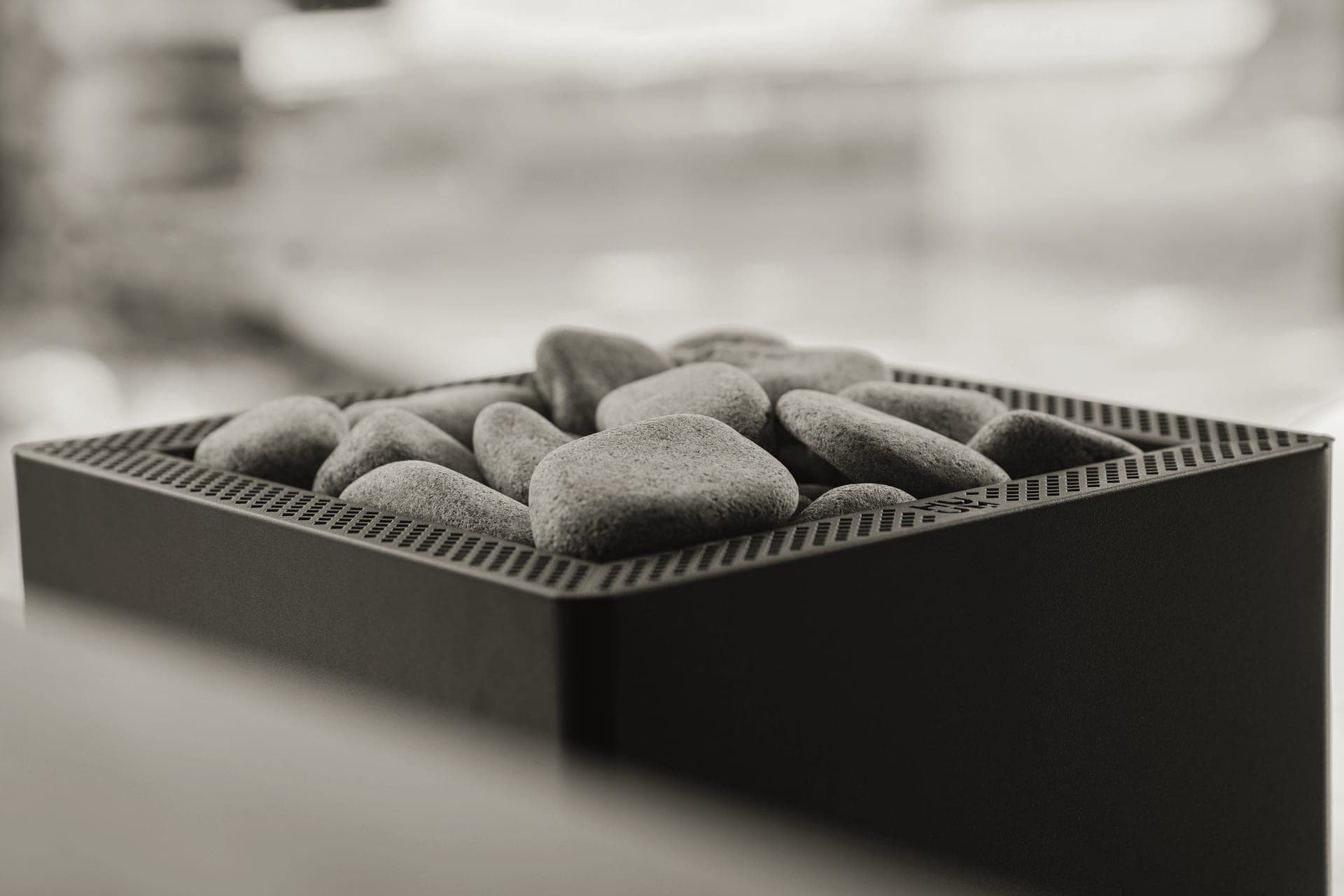
The short version: a traditional sauna with stones is dry when you leave the water alone and wet when you throw it. Same room, same heater, same temperature setting — the humidity is the variable and you control it with a ladle. What is not interchangeable is the equipment: a heater rated for wet use can take water on the stones, an infrared cabin has no stones at all, and a steam room is a different appliance entirely. Most of the confusion in this comparison comes from those three being described with the same two words.
What each term actually means
| Heat source | Typical air | Water on stones? | |
|---|---|---|---|
| Traditional sauna, run dry | Stove with stones | Hot, low humidity | You choose not to |
| Traditional sauna, run wet (löyly) | Stove with stones | Hot, with humidity bursts | Yes — the point of it |
| Infrared cabin | Radiant panels | Warm, ambient humidity | No — no stones |
| Steam room | Steam generator | About 110–120 °F, saturated | Not applicable — it is all steam |
Temperature ranges as covered on our sauna temperature guide and steam-generator sources, read on 2026-09-27.
What löyly does to the session
Throwing water on hot stones does not raise the room temperature meaningfully — it raises the humidity for thirty seconds or so, and humid air moves heat into your skin far faster than dry air does. The sensation is a wave: sharp, brief and considerably hotter than the thermometer says. Between throws the room dries out again. That cycle is what Finnish sauna practice is built around, and it is why the same 175 °F room can feel gentle or brutal depending entirely on the person holding the ladle. Our Finnish sauna guide covers the practice and sauna temperature guide the numbers.
The specification that decides whether you can go wet
Heaters are sold as dry-only or as wet-and-dry, and the distinction is about how the element and casing tolerate water and steam. Listings that state "wet or dry" — the 9 kW unit on one outdoor brand's cabins says exactly that — are telling you water on the stones is within spec. A heater without that statement, and any heater with an exposed element and no proper stone bed, should be run dry. The same goes for stones: sauna stones are chosen to survive repeated heating and quenching, and ordinary rock can crack or spit. Our sauna stones guide covers what belongs in the basket, and best sauna heaters covers the heaters themselves.
Where infrared sits
Outside this comparison, honestly. An infrared cabin has no stones, no water and no steam, and it runs at 120 to 150 °F rather than 175 to 195 °F. Calling it a dry sauna is technically true and practically misleading: the heat reaches you as radiation rather than as hot air, and there is no wet mode to switch into. If that distinction matters to you, infrared vs traditional sauna is the page, and sauna vs steam room covers the other end.
Which should you run?
- Dry, if you want longer sessions and a gentler curve. Lower humidity means sweat evaporates and your body copes for longer.
- Wet, if you want intensity in short waves — and if you like the smell of the steam and whatever you put in the water.
- Wet, if you have a good stone load. Löyly quality is a function of stone mass; a heater carrying 40 pounds gives a thinner burst than one carrying 150.
- Dry, if the room is not built for humidity — no foil vapor barrier, no ventilation, wood you care about. Our DIY sauna build guide covers what a wet room needs.
- Alternate. Most experienced bathers do: dry to warm through, then löyly, then out.
What wet use costs the room
More than people expect. Repeated humidity is what makes the vapor barrier, the ventilation and the bench spacing matter — a room that never sees water forgives a lot of build shortcuts, and a room that gets löyly three times a week does not. If you are retrofitting an existing space, the honest sequence is: check the heater is rated for wet use, check the room can dry between sessions, then start throwing water. Our sauna and cold plunge setup page covers the wider build.
What a wet-capable sauna needs
Harvia KIP 6 kW Sauna Heater with Built-In Controls
Harvia
#ad Price as of Sep 27, 2026. We earn a commission if you buy, at no extra cost to you. How this is funded.
The KIP's larger stone chamber is the reason to choose it over the Topclass: more stone mass means better heat retention and a softer steam when you throw water.
| Output | 6 kW |
|---|---|
| Rated room volume | 177–283 cubic feet |
| Voltage | 240 V, single phase |
| Controls | Built in |
| Stone space | Larger than the Topclass |
| Casing | Low outer surface temperature |
What works
- More stone mass gives a gentler, wetter loyly
- Low outer casing temperature is a genuine safety feature in a small room
- Same published volume-rating discipline as the rest of the Harvia line
What doesn't
- Built-in controls put the dial inside the hot room
- More stones is more weight on the wall bracket
- Slightly longer initial warm-up than a low-mass heater
Skip it ifyou want to preheat from indoors on a timer. Built-in controls put every adjustment inside the sauna.
Specs above are the manufacturer's published figures — source.
AURGOD 2-Person Indoor Traditional Sauna, Canadian Hemlock, 6 kW Harvia
AURGOD
$2,990.00 · 7% off
#ad Price as of Sep 27, 2026. We earn a commission if you buy, at no extra cost to you. How this is funded.
A named Harvia heater in a hemlock room with the full accessory set in the box — an indoor traditional sauna that is complete on day one.
| Capacity | 2 person |
|---|---|
| Wood | Canadian hemlock |
| Heater | 6 kW Harvia electric, 220 V |
| Temperature range | 120–195 °F |
| Dimensions | 51" × 41" × 75" |
| Weight | 600 lb |
| Included | 8 mm tempered door, stones, bucket and ladle, hygrometer, hourglass |
What works
- A Harvia heater with a parts channel
- True traditional temperatures
- Everything for the first session included
What doesn't
- Needs a 220–240 V circuit
- Listed as a "steam" sauna — it is a traditional room that takes water on stones
- 600 lb of panels to move in
Skip it ifyou cannot add a 240 V circuit where it will go.
Northwood Sauna Diabase Sauna Stones
Northwood Sauna
#ad Price as of Sep 27, 2026. We earn a commission if you buy, at no extra cost to you. How this is funded.
Diabase is the traditional sauna stone, and this is a large enough box to fill a typical 6 kW heater with some to spare for sorting.
| Stone | Diabase (subvolcanic) |
|---|---|
| Origin | Germany, per the listing |
| Shipping weight | 44.7 lb |
| Cut | Natural, hand-picked |
What works
- The traditional stone type
- Generous quantity
- Described as crack-resistant
What doesn't
- Stone size range not stated in the feature text
- Needs rinsing before first use
- Check your heater manual for the quantity it takes
Skip it ifyour heater's manual specifies a different stone type or size. Follow the manual.
HSE Canadian Red Cedar Sauna Bucket and Ladle, 6 L
Home Sauna Experience
#ad Price as of Sep 27, 2026. We earn a commission if you buy, at no extra cost to you. How this is funded.
Publishes both the bucket volume and the ladle capacity, which together tell you how many throws a fill gives you — the one genuinely useful number in this category.
| Capacity | 6 liters (1.5 gallons) |
|---|---|
| Wood | Canadian red cedar |
| Ladle | 14", hewn from a single piece, roughly 150 ml |
| Dimensions | 11.4" × 11.4" × 9.4" |
| Weight | 3.54 pounds |
| Liner | Not published as included |
What works
- Both bucket volume and ladle capacity published — roughly 40 throws per fill
- A single-piece ladle has no joint to loosen in heat
- Real dimensions and weight given rather than photographs alone
What doesn't
- No liner published, so the cedar is in direct contact with water
- 6 L is heavy to carry full and more than a short session needs
- Cedar left wet will stain and eventually split — it needs drying between uses
Skip it ifyou take short sessions alone. A 4 L bucket is lighter, cheaper and still more water than one person will throw.
CedarLuma 1-Person Infrared Sauna with 660/850 nm Red Light
CedarLuma
#ad Price as of Sep 27, 2026. We earn a commission if you buy, at no extra cost to you. How this is funded.
Publishes an EMF range rather than the word "low", and a realistic warm-up time — up to 149 °F in 45 to 50 minutes — which almost no one does.
| EMF, as published | 1.4–2.6 mG; no measurement distance given |
|---|---|
| Power | 1,170 W |
| Heaters | 7 carbon fiber panels |
| Warm-up | Up to 149 °F in 45–50 minutes, per the listing |
| Wood | Solid Canadian hemlock |
| Dimensions | 31.5" × 31.5" × 63.3" |
| Weight | 188 lb |
What works
- A numeric EMF range, not just a claim
- An honest warm-up time
- Standard-outlet power for a one-person cabin
What doesn't
- No distance for the EMF figure, so it cannot be compared precisely
- "FDA-certified" red light is the seller's description; we have not verified it
- One person only
Skip it ifyou need to compare EMF figures like for like. Without a distance, no Amazon listing here can be.
A heater with a proper stone bed, a room built around it, stones that survive quenching, and a bucket and ladle. The infrared cabin is here as the contrast: the same word, a different machine.
Questions people actually ask
What is the difference between a dry and a wet sauna?
Is an infrared sauna a dry sauna?
Can you pour water on any sauna heater?
Which is better for you, dry or wet?
Does a wet sauna need different ventilation?
Sources
- InfoFinland — Finnish sauna, löyly and temperature range — checked Sep 27, 2026
- Backyard Discovery — PrairieFire heater described as wet or dry — checked Sep 27, 2026
- Harvia — KIP60 heater specifications and stone capacity — checked Sep 27, 2026
- Finlandia Sauna — contractor specification, ventilation and vapor barrier — checked Sep 27, 2026
- Tylo — FAQ, no drain required as water evaporates during the session — checked Sep 27, 2026
Read next
- Sauna vs steam roomThe genuinely different appliance.Read it
- Finnish sauna guideLöyly, and how to do it.Read it
- Infrared vs traditional saunaWhere infrared actually sits.Read it
- Sauna stones guideWhat survives the quench.Read it
- Best sauna heatersWet-rated units.Read it
- Sauna temperature guideThe numbers behind both modes.Read it
Every pick on this page comes from published specifications, not from hardware we own. Read how we pick — including what spec-led ranking cannot tell you.