Sauna stones: the consumable everyone forgets
Stones are not decoration and they are not permanent. They are the thermal mass that makes steam possible, and when they degrade they shorten your heater's life.
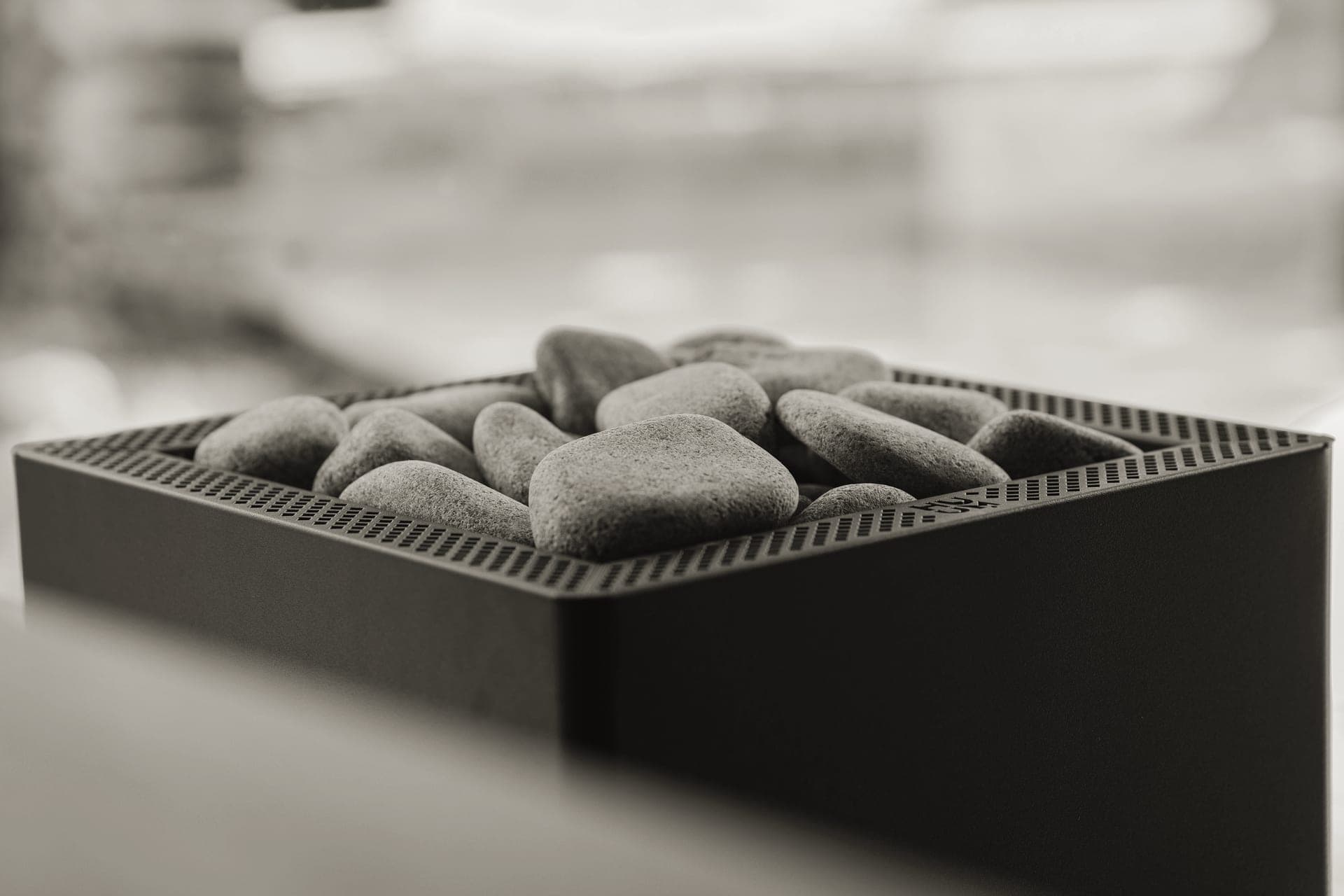
Sauna stones do two jobs. They store heat, which is what lets a sauna hold temperature and recover after the door opens. And they flash water into steam when you throw it, which is what produces loyly — the burst of humid heat that is the point of a traditional sauna.
They are also a consumable. They crack, they crumble, and when they do they take your heater with them.
Why degraded stones damage the heater
What stones are used
Sauna stones are dense igneous rock — typically peridotite, olivine or similar — chosen because they tolerate repeated heating and rapid cooling without shattering. Two properties matter: thermal mass, so they store heat, and thermal shock resistance, so throwing water on them does not crack them immediately.
Do not substitute stones from a garden or a beach. River stones in particular can contain trapped moisture, and moisture inside a rock heated to several hundred degrees expands — which is a genuine safety issue, not a performance one. Use stones sold for saunas.
How to stack them
This matters more than most people realize and it is where the airflow question is decided.
- 1Follow your heater's manual first. Quantity and arrangement are specified per model and the manual outranks anything on this page.
- 2Stack, do not pack. Stones should rest against each other with gaps between them, not be wedged in solid. The gaps are the airflow.
- 3Larger stones at the bottom, smaller above. This is the arrangement that maintains air channels rather than letting small stones settle into every gap.
- 4Do not overfill. More stones is not more heat — past the manual's stated quantity you are restricting airflow, which is the exact failure mode this whole page is about.
- 5Cover the elements but do not crush them. Elements should be surrounded by stone, not bearing weight.
Stone mass and the heat you get
| Larger stone mass | Smaller stone mass | |
|---|---|---|
| Warm-up time | Longer | Shorter |
| Heat retention | Better | Worse |
| Recovery after the door opens | Faster | Slower |
| Loyly when you throw water | Softer, wetter, more sustained | Sharper, drier, briefer |
| Weight on the wall bracket | More | Less |
Neither is better — they are different experiences. Harvia's KIP is explicitly the larger-stone option in its 6 kW range, which is why it is a genuine alternative to the Topclass rather than simply a different casing.
When to replace them
Manufacturers generally advise inspecting stones at least annually. Check your own heater's manual, since the recommendation varies by model and by how heavily the heater is used.
What you are looking for when you inspect:
- Cracked stones — replace them.
- Crumbled fragments and grit in the bottom of the chamber — clear it out, because that is what restricts airflow.
- Stones that have become rounded or reduced in size, which means they have been shedding material.
- Any stone that breaks when you pick it up. That is a stone that was going to fail in service.
The routine is simple: turn the heater off and let it cool completely, lift all the stones out, discard the damaged ones, clear the debris from the chamber, and restack — larger at the bottom, gaps maintained. Twenty minutes, once a year, and it is the single most useful thing you can do for heater longevity. It is on our winter maintenance checklist for exactly that reason.
Throwing water properly
Water goes on the stones, from a ladle, in sensible quantities. Three reasons that matters:
- 1Water on elements thermally shocks them, and repeated shock cracks the sheath. Aim at the stone bed.
- 2A ladle controls the quantity. Emptying a jug floods the stone bed, cools it sharply and produces a short burst rather than sustained steam.
- 3Small throws, repeated, give you a better sauna than one large one — the stone mass has a chance to recover between them.
Additives: check the manual
Essential oils and sauna fragrances are added to the water, heavily diluted, and some manufacturers advise against them entirely. Never pour oil directly onto hot stones — undiluted oil on a very hot surface can ignite.
Residues also build up on stones and elements over time, which is another reason manufacturers are cautious. Your heater manual is the authority here, not general practice.
Are stones included?
Sometimes, and it varies. Harvia's electric heaters generally include stones — though owners often upgrade the basic grade supplied. Wood stoves frequently do not: one stove in our survey publishes a 55 lb stone capacity with the stones explicitly not included, and 55 lb of sauna stone is a real additional cost.
Check before ordering, because it is a line item people miss.
Questions people actually ask
How often should sauna stones be replaced?
Why do sauna stones need replacing?
How should you stack sauna stones?
Can you use any rocks in a sauna?
Do sauna heaters come with stones?
Sources
- Harvia — heater manuals, stone quantity, arrangement and maintenance guidance — checked Sep 7, 2026
- Amazon.com — sauna heater listings, stone inclusion and capacity as published by the sellers — checked Sep 7, 2026
Read next
- How long do sauna heaters lastWhere stone condition does its damage.Read it
- Best sauna heatersIncluding the larger-stone option.Read it
- Outdoor sauna winter maintenanceThe annual routine.Read it
- Sauna temperature guideWhat the stones are getting you to.Read it
- Best sauna stonesWhat to order when yours need replacing.Read it
- Best sauna scentsScent in the water, not on the stones.Read it
- Best sauna cleaners and wood oilsThe rest of the upkeep.Read it
- HUUM heaters comparedWhich heaters hold the most stone.Read it
- How to clean a saunaThe annual stone check.Read it
Every pick on this page comes from published specifications, not from hardware we own. Read how we pick — including what spec-led ranking cannot tell you.