How long do sauna heaters last?
No manufacturer publishes a figure, so we will not invent one. What we can tell you is exactly what shortens a heater's life, and all of it is within your control.
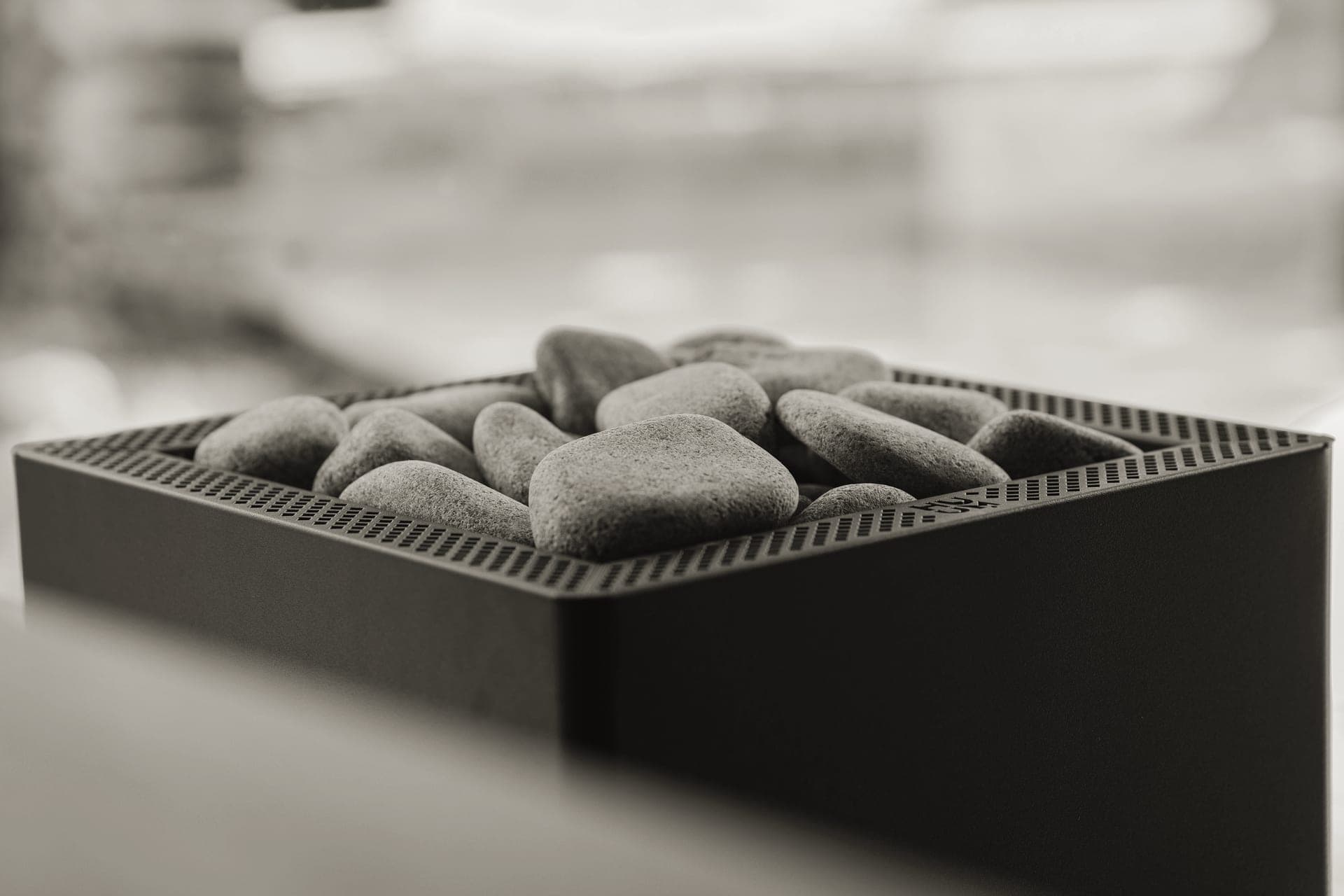
What actually kills sauna heaters
1. Degraded stones (the big one)
Sauna stones crack and crumble with thermal cycling. As they break down, the fragments pack together and restrict airflow through the heater. Restricted airflow means the elements cannot shed heat into moving air, so they run hotter than designed — and heat is what kills a heating element.
This is the most common cause of premature element failure and it is completely preventable. Manufacturers generally advise inspecting stones at least annually; check your own heater's manual, since the recommendation varies by model. Sauna stones guide covers how to turn them out.
2. Undersizing
A heater too small for the room runs at or near maximum output constantly, because it never satisfies the thermostat. Continuous maximum-output operation is a harder duty cycle than intermittent cycling, and it shortens element life.
This is the second cost of undersizing, on top of a room that never gets properly hot: you also replace the heater sooner. See sauna heater sizing guide.
3. Poor ventilation
A sauna needs an air inlet low near the heater and an outlet high on the opposite wall. That airflow is not only for the occupants — it is part of how the heater sheds heat into the room rather than into itself.
A room with token ventilation runs the heater hotter for the same room temperature. It also feels stuffy well before it is actually too hot, which is the symptom people notice first.
4. Water on the elements
Water goes on the stones, not on the elements. Throwing water directly onto a hot element thermally shocks it, and repeated shock cracks the sheath. Use a ladle rather than a jug, aim at the stone bed, and use a sensible quantity rather than emptying the bucket.
5. Additives
Essential oils and sauna fragrances go into the water in very small quantities, if at all — and some manufacturers advise against them entirely. Undiluted oil poured onto hot stones can ignite, and residues build up on stones and elements. Check your heater's manual before using anything but water, because this varies by manufacturer.
The failure modes, and which are repairable
| Failure | Symptom | Repairable? |
|---|---|---|
| Element failure | Room does not reach temperature, or heater dead | Yes — if replacement elements exist |
| Thermostat failure | Overheats, or will not switch on | Yes — usually a serviceable part |
| Contactor failure | Clicks, intermittent operation | Yes — a standard component |
| Casing corrosion | Rust, particularly on outdoor wood stoves | Depends on extent |
| Stone bed degradation | Reduced airflow, longer warm-up | Yes — replace the stones |
Most of these are repairable if parts exist. That is the entire argument for a named brand: a Harvia element is orderable in year eight, and an unbranded element in an anonymous cabin heater frequently is not.
Why brand matters here specifically
A sauna heater is a serviceable appliance made of replaceable parts. What determines whether a ten-year-old heater is repairable or scrap is not build quality so much as whether the manufacturer still supplies parts that fit.
That is the practical case for buying a named brand, and it is stronger than the case based on build quality. An unbranded 6 kW element in a barrel package works fine until it fails, at which point you are measuring the hole and hoping something fits.
What long-life buying looks like
Harvia Topclass 6 kW Electric Sauna Heater
Harvia
#ad We earn a commission if you buy, at no extra cost to you. How this is funded.
Harvia publishes the room volume each heater is rated for. That single number solves the entire heater-selection problem, and most brands will not give it to you.
| Output | 6 kW |
|---|---|
| Rated room volume | 177–283 cubic feet |
| Voltage | 240 V, single phase |
| Control | Integrated panel, mountable either side |
| Stones | Included |
| Type | Wall-mounted electric |
What works
- Rated room volume published as a range — the spec that decides the purchase
- Control panel can go on either side, which matters in a tight room
- Harvia elements and parts are genuinely available years later
What doesn't
- Requires a dedicated 240 V circuit
- Included stones are the basic grade and many owners upgrade them
- The volume rating assumes an insulated room; an uninsulated one needs more heater
Skip it ifyour room is over 283 cubic feet. Undersizing a heater is the most common and most expensive sauna mistake — step up to the 8 kW.
Specs above are the manufacturer's published figures — source.
Harvia KIP 6 kW Sauna Heater with Built-In Controls
Harvia
#ad Price as of October 23, 2026. We earn a commission if you buy, at no extra cost to you. How this is funded.
The KIP's larger stone chamber is the reason to choose it over the Topclass: more stone mass means better heat retention and a softer steam when you throw water.
| Output | 6 kW |
|---|---|
| Rated room volume | 177–283 cubic feet |
| Voltage | 220–240 V |
| Controls | Built in, digital |
| Mounting | Wall mount |
| Stone space | Larger than the Topclass |
| Casing | Low outer surface temperature |
What works
- More stone mass gives a gentler, wetter loyly
- Low outer casing temperature is a genuine safety feature in a small room
- Same published volume-rating discipline as the rest of the Harvia line
What doesn't
- Built-in controls put the panel inside the hot room
- More stones is more weight on the wall bracket
- Slightly longer initial warm-up than a low-mass heater
Skip it ifyou want to preheat from outside the room. Built-in controls put every adjustment inside the sauna — the KIP W and E models take a separate control unit instead.
Specs above are the manufacturer's published figures — source.
Red Cedar Sauna Thermometer and Hygrometer, Wall Mount
DUNUO
#ad We earn a commission if you buy, at no extra cost to you. How this is funded.
Battery free is non-negotiable in a room that reaches 190 °F. Anything with a cell in it will fail, and will probably leak while doing so.
| Type | Combined thermometer and hygrometer |
|---|---|
| Scale | °F and °C |
| Power | None — mechanical |
| Mounting | Wall |
| Material | Red cedar surround |
| Stated accuracy | Not published |
What works
- No battery to cook, leak or replace
- Dual scale removes unit confusion with imported heaters
- Reads humidity as well as temperature
What doesn't
- No published accuracy tolerance
- Combined gauges are less accurate than separate instruments
- Hygrometers drift and cannot easily be recalibrated
Skip it ifyou need accuracy rather than indication. Analog sauna gauges are directional instruments; if you need a real number you need a lab thermometer.
The maintenance that actually extends life
- 1Inspect and turn the stones at least annually, or per your heater's manual. Replace cracked and crumbled ones. This is the single highest-value maintenance action.
- 2Do not overfill the stone chamber. Stones should be stacked to allow air through, not packed solid. Follow the manual's guidance on quantity and arrangement.
- 3Keep the ventilation clear. Check the inlet and outlet are not blocked by a bench, a towel or debris.
- 4Throw water on stones, with a ladle, and in sensible quantities.
- 5Leave the door ajar after a session so the room and the heater dry rather than sitting warm and damp.
- 6Do not run the heater unattended for extended periods beyond what the manufacturer specifies.
When to replace rather than repair
Repair if parts exist and the failure is a single component. Replace if the heater was undersized for the room in the first place — repairing an undersized heater buys you a heater that will fail the same way — or if parts are genuinely unobtainable, or if the casing has corroded structurally on an outdoor stove.
If you are replacing, redo the sizing arithmetic rather than matching what was there. The original may have been undersized, and that may be why you are replacing it.
Questions people actually ask
How long does a sauna heater last?
What causes sauna heater elements to fail?
Can you replace a sauna heater element?
How often should you replace sauna stones?
Can you put essential oils in a sauna?
Sources
- Harvia — heater manuals, stone maintenance and operating guidance — checked Sep 7, 2026
- Amazon.com — sauna heater listings, warranty and parts information as published by the sellers — checked Sep 7, 2026
Read next
- Sauna stones guideThe maintenance that matters most.Read it
- Sauna heater sizing guideWhy undersizing costs twice.Read it
- Best sauna heatersBrands with a parts tail.Read it
- Harvia vs HUUMWhere brand genuinely matters.Read it
- Sauna and cold plunge warranties comparedWhat heater warranties cover.Read it
- Best sauna controllersReplacing a failed panel.Read it
Every pick on this page comes from published specifications, not from hardware we own. Read how we pick — including what spec-led ranking cannot tell you.