Harvia vs HUUM
Two respected Nordic and Baltic heater brands with different design philosophies. Here is how they differ, what each publishes, and which is easier to actually buy.
The two philosophies
Harvia is the volume manufacturer of the sauna world — a broad range from basic wall-mounted units to designed pieces, sold widely, with parts available years later. Its defining virtue for a buyer is disclosure: it publishes a rated room volume for each heater, which is the number that decides the purchase.
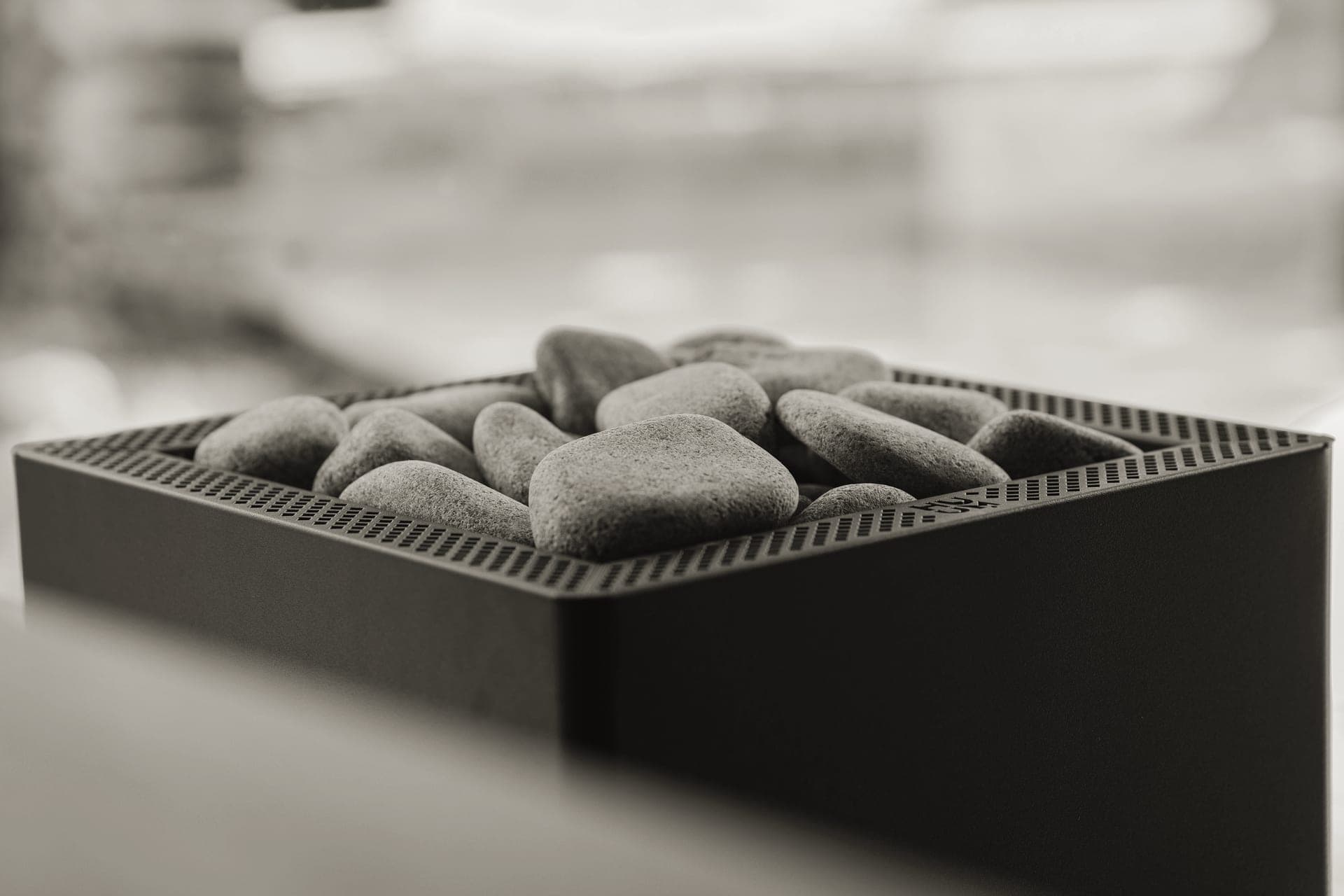
HUUM is the design-led Estonian brand, known for heaters that treat the stone mass as the visual center of the room rather than as a functional necessity hidden in a casing. Its products are aesthetically distinctive in a way Harvia's mainstream line is not.
That is a real difference in what each is optimizing for, and both are legitimate. Which matters to you depends on whether the heater is a component or a feature of the room.
What Harvia publishes
| Model | Rated room volume | Controls | Distinguishing feature |
|---|---|---|---|
| Topclass 6 kW | 177–283 cu ft | Integrated panel, either side | Mountable control position |
| KIP 6 kW | 177–283 cu ft | Built in | Larger stone chamber |
| The Wall 6 kW | Stated as medium rooms | Illuminated panel | Black steel, design-led |
Note the third row: even within Harvia's own range, the design-led model publishes 'medium rooms' rather than a cubic-foot figure. Disclosure is not uniform even within a brand, which is worth knowing when you shop.
The stone mass question
This is the genuinely useful technical difference to understand, and it applies to any heater comparison rather than just this one.
More stone mass means more thermal storage. The room takes slightly longer to reach temperature, holds it better, recovers faster after the door opens, and produces a softer, wetter loyly when you throw water — because there is more hot mass to flash the water into steam.
Less stone mass means faster warm-up and a sharper, drier heat. Neither is better; they are different experiences. Harvia's KIP is explicitly the larger-stone option in its range, which is why it appears on our heaters roundup alongside the Topclass rather than instead of it.
HUUM's design language centers on large visible stone masses, which suggests a similar priority. We cannot quantify it without published figures, so we are describing the design intent rather than claiming a measurement.
Availability, which is a real consideration
Harvia is straightforwardly buyable — multiple models, multiple sellers, on the marketplace we can link. HUUM is sold through dealers and specialist retailers, which means a longer purchase process and, in some regions, longer lead times.
That is not a criticism of HUUM; dealer channels often come with better support and installation help. It is a practical difference in how you buy, and it affects how quickly you get a sauna.
Parts, which matters more than either
A sauna heater is a serviceable appliance. Elements fail, thermostats fail, and in year eight the question is whether a replacement part exists that fits the same opening.
Both are established manufacturers with real parts channels, which puts them in a completely different category from the unbranded elements shipped in many barrel and cabin packages. That gap — named brand versus unbranded — matters far more than the gap between Harvia and HUUM. If you are choosing between either of these and a nameless 6 kW element, the answer is not close.
The questions to ask either
- What is the rated room volume in cubic feet? Not a person count, not 'medium rooms'.
- What stone capacity does it take, and are stones included? Frequently they are not, and stones are a real cost.
- What circuit does it need? Voltage and amperage, from the installation manual.
- Where do the controls live? Inside the hot room, or on a wall panel that allows scheduling.
- What is the warranty, and how long are elements available?
Our position
If you want a heater you can order today with a published volume rating and a long parts tail, Harvia is the practical answer and it is what we have ranked. If the heater is a visual centerpiece of the room and you are willing to buy through a dealer, HUUM is a legitimate choice and we are not going to pretend to rank a product we could not obtain specifications for.
What we would say confidently: choose either over an unbranded element. The published rating and the parts availability are worth the premium, and they are what you are actually paying for.
Harvia models available on Amazon
Harvia Topclass 6 kW Electric Sauna Heater
Harvia
#ad We earn a commission if you buy, at no extra cost to you. How this is funded.
Harvia publishes the room volume each heater is rated for. That single number solves the entire heater-selection problem, and most brands will not give it to you.
| Output | 6 kW |
|---|---|
| Rated room volume | 177–283 cubic feet |
| Voltage | 240 V, single phase |
| Control | Integrated panel, mountable either side |
| Stones | Included |
| Type | Wall-mounted electric |
What works
- Rated room volume published as a range — the spec that decides the purchase
- Control panel can go on either side, which matters in a tight room
- Harvia elements and parts are genuinely available years later
What doesn't
- Requires a dedicated 240 V circuit
- Included stones are the basic grade and many owners upgrade them
- The volume rating assumes an insulated room; an uninsulated one needs more heater
Skip it ifyour room is over 283 cubic feet. Undersizing a heater is the most common and most expensive sauna mistake — step up to the 8 kW.
Specs above are the manufacturer's published figures — source.
Harvia KIP 6 kW Sauna Heater with Built-In Controls
Harvia
#ad Price as of October 23, 2026. We earn a commission if you buy, at no extra cost to you. How this is funded.
The KIP's larger stone chamber is the reason to choose it over the Topclass: more stone mass means better heat retention and a softer steam when you throw water.
| Output | 6 kW |
|---|---|
| Rated room volume | 177–283 cubic feet |
| Voltage | 220–240 V |
| Controls | Built in, digital |
| Mounting | Wall mount |
| Stone space | Larger than the Topclass |
| Casing | Low outer surface temperature |
What works
- More stone mass gives a gentler, wetter loyly
- Low outer casing temperature is a genuine safety feature in a small room
- Same published volume-rating discipline as the rest of the Harvia line
What doesn't
- Built-in controls put the panel inside the hot room
- More stones is more weight on the wall bracket
- Slightly longer initial warm-up than a low-mass heater
Skip it ifyou want to preheat from outside the room. Built-in controls put every adjustment inside the sauna — the KIP W and E models take a separate control unit instead.
Specs above are the manufacturer's published figures — source.
Harvia The Wall 6 kW Electric Sauna Heater
Harvia
#ad Price as of October 23, 2026. We earn a commission if you buy, at no extra cost to you. How this is funded.
The same Harvia engineering in a flat black case that does not look like equipment. If your room is a design project as well as a sauna, this is the one.
| Output | 6 kW |
|---|---|
| Voltage | 240 V |
| Finish | Black steel |
| Control | Illuminated operating panel |
| Room size | Stated as designed for medium rooms |
| Stones | Included |
What works
- A genuinely different visual language from a standard heater
- Illuminated panel is readable in a dim room
- Harvia internals behind the styling
What doesn't
- Room volume is stated as 'medium' rather than in cubic feet
- Black casing shows dust and mineral marks
- Styling carries a price premium
Skip it ifyou need an exact volume rating to size it. 'Medium rooms' is not a number, and the Topclass publishes one.
Specs above are the manufacturer's published figures — source.
Questions people actually ask
Is Harvia or HUUM better?
Does sauna heater stone mass matter?
Can you buy HUUM heaters on Amazon?
Is a branded sauna heater worth the money?
Sources
- Harvia — heater specifications and rated room volumes — checked Sep 7, 2026
- HUUM — manufacturer site and dealer model — checked Sep 7, 2026
- Amazon.com — Harvia heater listings, specifications as published by the sellers — checked Sep 7, 2026
Read next
- Best sauna brandsEvery brand, ranked by what it actually publishes.Read it
- Best sauna heatersThe full ranking, both fuel types.Read it
- Sauna heater sizing guideThe volume arithmetic.Read it
- Electric vs wood-burning heatersThe decision before the brand.Read it
- Best sauna controllersThe two control ecosystems.Read it
- Best sauna heater guardsBoth makers' rails.Read it
- HUUM heaters comparedEvery HUUM family, by stone load.Read it
Every pick on this page comes from published specifications, not from hardware we own. Read how we pick — including what spec-led ranking cannot tell you.