Electric vs wood-burning sauna heaters
Presented as a preference question and mostly a budget one. A wood stove removes the largest line item in an outdoor sauna project — and costs you 45 minutes every session.
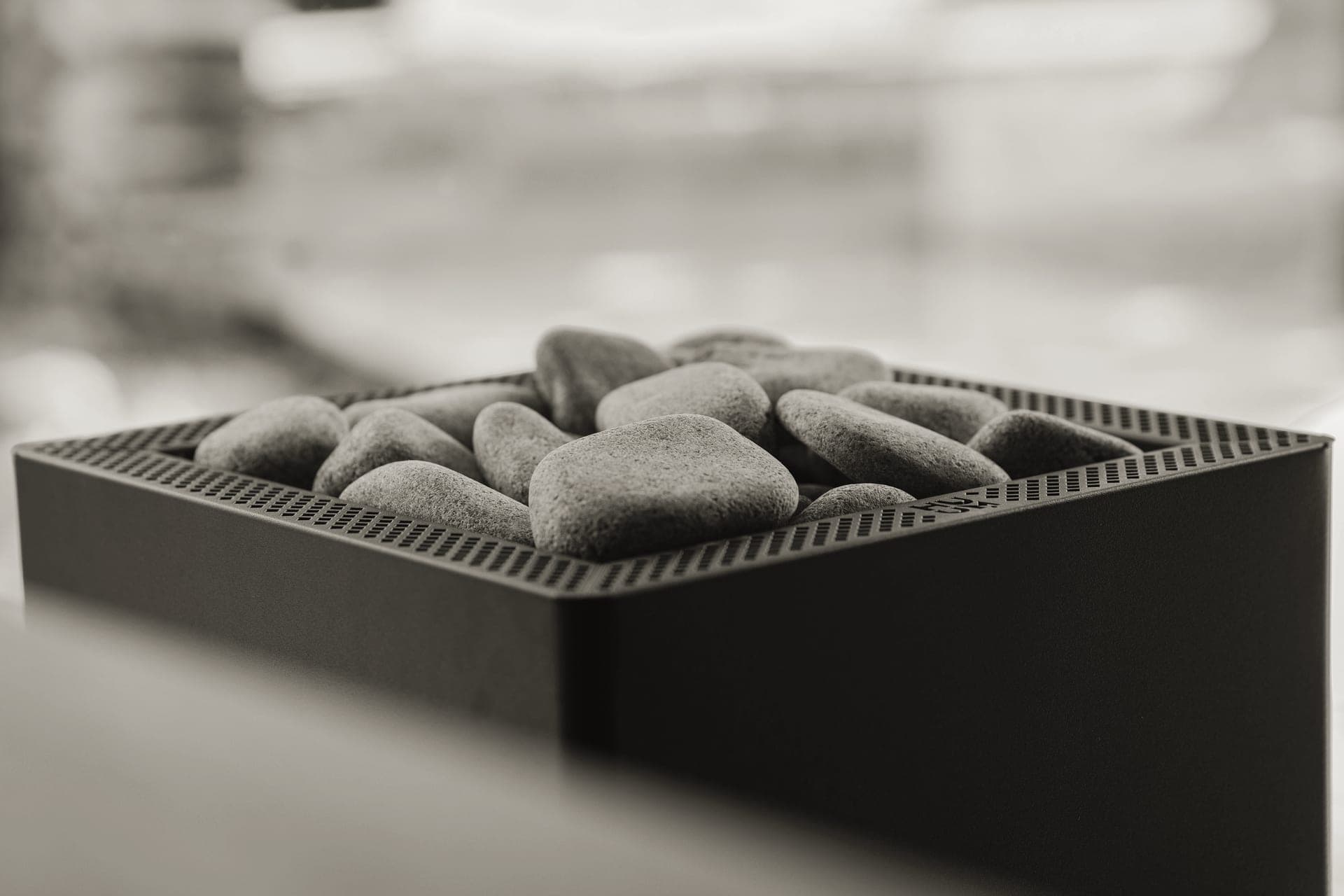
The short verdict: if 240 V to your sauna is easy, electric is more convenient and most people should take it. If that run is long, trenched or expensive — which on a typical suburban lot it is — a wood stove removes the cost entirely and gives you a heat many enthusiasts prefer. The lead time is what you pay instead.
| Electric | Wood-burning | |
|---|---|---|
| Circuit | 240 V dedicated, above ~4.5 kW | None |
| Install cost | Trench, permit, electrician | Chimney and clearances only |
| Lead time | Preheat, often schedulable | ~45 min, attended |
| Ongoing cost | Electricity | Firewood |
| Cold-climate headroom | Fixed at the heater's rating | Feed it more wood |
| Effort per session | Press a button | Light, tend, empty the ash |
| Indoor or attached | Straightforward | Difficult — flue and clearances |
| Heat character | Steady, thermostatic | Rises and falls with the fire |
| Rated by | kW | Electric equivalence |
How wood stoves are rated
Wood stoves publish an electric-equivalent rating — "9–15 kW equivalent", "15 kW equivalent" — because that is the only comparison that means anything across the two technologies. A 15 kW-equivalent stove puts out considerably more heat than any residential electric heater, which is why wood-fired is the natural answer for large rooms and hard winters.
Two specs separate a stove that lasts a decade from one that rusts through in three winters:
- 304 stainless steel. The correct grade for a hot, wet outdoor environment. A stove that names the grade is telling you something; one that says only 'stainless steel' is telling you less.
- Published stone capacity in pounds. Thermal mass determines how the heat behaves after the fire dies down and how well it takes a water throw. One stove in our survey publishes 55 lb — and note the stones are usually not included at that weight.
The install cost is the real comparison
Every electric heater above roughly 4.5 kW needs 240 V. To the back of a garden that means a trench, conduit, a permitted circuit and an electrician's time. We cannot give you a figure — it depends entirely on distance, local permit regime and rates — but it is routinely the largest single line in an outdoor sauna budget.
A wood stove needs none of it. What it needs instead is a correctly installed chimney with correct clearances, which is a specified job with a documented spec rather than an open-ended cost. That asymmetry is the substance of this decision. Full detail in the electrical guide, and the chimney itself in best sauna chimney kits.
The heat genuinely differs
An electric heater holds a setpoint. A wood stove peaks and declines with the fire, so a session has an arc — hottest shortly after a good load, gentler as it burns down. Many enthusiasts prefer that, and a stove with a large stone mass smooths it considerably.
There is also the fire itself: the sound, the smell, the ritual of building it. That is not a specification and we are not going to pretend it is, but it is why people who could easily run a circuit choose wood anyway.
The honest downsides of wood
- 145 minutes of lead time, attended, every session. You cannot decide to have a sauna in twenty minutes. In January that means standing outside lighting a fire.
- 2Ash management. A removable ash tray makes it a 30-second job; without one it is a chore. Check for it.
- 3Firewood storage. Dry, seasoned wood, under cover, in quantity — that is a space commitment.
- 4Chimney maintenance. Flues need periodic inspection and cleaning.
- 5It cannot go indoors or attached without serious flue engineering, and often not at all.
Running cost
Electric: a 6 kW heater at rated draw for 45 minutes is 4.5 kWh, about $0.77 at $0.17/kWh — and the real figure is lower because the elements cycle once the room is up to temperature. Wood: the cost of the firewood you burn, which varies enormously by region and by whether you buy it or cut it.
Neither is expensive per session, and running cost should not decide this. Install cost and lead time should. Full arithmetic in sauna running costs.
Which to buy
Electric if the sauna is indoors, attached, or close enough to the panel that a circuit is straightforward — and if you value being able to press a button and sit down 30 minutes later.
Wood if the sauna is a freestanding outbuilding, the electrical run is long, you live somewhere genuinely cold, or you actively want the ritual. It is not the budget option so much as the option that removes a different cost entirely.
A heater from each side
Harvia Topclass 6 kW Electric Sauna Heater
Harvia
#ad We earn a commission if you buy, at no extra cost to you. How this is funded.
Harvia publishes the room volume each heater is rated for. That single number solves the entire heater-selection problem, and most brands will not give it to you.
| Output | 6 kW |
|---|---|
| Rated room volume | 177–283 cubic feet |
| Voltage | 240 V, single phase |
| Control | Integrated panel, mountable either side |
| Stones | Included |
| Type | Wall-mounted electric |
What works
- Rated room volume published as a range — the spec that decides the purchase
- Control panel can go on either side, which matters in a tight room
- Harvia elements and parts are genuinely available years later
What doesn't
- Requires a dedicated 240 V circuit
- Included stones are the basic grade and many owners upgrade them
- The volume rating assumes an insulated room; an uninsulated one needs more heater
Skip it ifyour room is over 283 cubic feet. Undersizing a heater is the most common and most expensive sauna mistake — step up to the 8 kW.
Specs above are the manufacturer's published figures — source.
Wood-Burning Sauna Heater and Chimney Kit, 15 kW Equivalent
Generic Amazon listing
#ad Price as of October 23, 2026. We earn a commission if you buy, at no extra cost to you. How this is funded.
304 stainless and a published stone capacity are the two specs that separate a stove lasting a decade from one that rusts through in three winters.
| Type | Wood burning, wet or dry |
|---|---|
| Output | 15 kW electric equivalent |
| Material | 304 stainless steel |
| Stone capacity | 55 lb (stones not included) |
| Maximum temperature | Up to 195 °F |
| Ash handling | Removable ash tray |
| Chimney | Included |
What works
- 304 stainless is the correct grade for a wet, hot, outdoor environment
- Stone capacity published in pounds — rare and genuinely useful
- Removable ash tray turns a chore into a 30-second job
What doesn't
- Stones are not included, and 55 lb of them is not cheap
- 15 kW equivalent will overheat a small barrel
- Wood firing means a lead time before every session
Skip it ifyour room is under about 250 cubic feet. This much stove in a small barrel is uncomfortable and wasteful.
Harvia KIP 6 kW Sauna Heater with Built-In Controls
Harvia
#ad Price as of October 23, 2026. We earn a commission if you buy, at no extra cost to you. How this is funded.
The KIP's larger stone chamber is the reason to choose it over the Topclass: more stone mass means better heat retention and a softer steam when you throw water.
| Output | 6 kW |
|---|---|
| Rated room volume | 177–283 cubic feet |
| Voltage | 220–240 V |
| Controls | Built in, digital |
| Mounting | Wall mount |
| Stone space | Larger than the Topclass |
| Casing | Low outer surface temperature |
What works
- More stone mass gives a gentler, wetter loyly
- Low outer casing temperature is a genuine safety feature in a small room
- Same published volume-rating discipline as the rest of the Harvia line
What doesn't
- Built-in controls put the panel inside the hot room
- More stones is more weight on the wall bracket
- Slightly longer initial warm-up than a low-mass heater
Skip it ifyou want to preheat from outside the room. Built-in controls put every adjustment inside the sauna — the KIP W and E models take a separate control unit instead.
Specs above are the manufacturer's published figures — source.
Questions people actually ask
Is a wood-burning sauna heater better than electric?
How are wood sauna stoves rated?
Can you use a wood sauna heater indoors?
What steel grade should a wood sauna stove be?
How much firewood does a sauna use?
Sources
Read next
Every pick on this page comes from published specifications, not from hardware we own. Read how we pick — including what spec-led ranking cannot tell you.