The best sauna chimney kits
A wood-burning sauna stove is the cheap part. The chimney is the part that decides whether the building is safe, and the one component where buying the wrong pipe is a fire rather than an inconvenience.
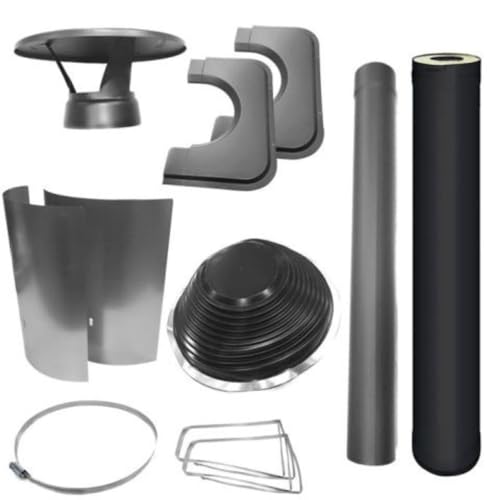
The verdict: if your sauna is a barrel, buy the Harvia barrel kit. It is a complete package — chimney, rain cap, the symmetrical rain flange, the insulated lead-through that carries the pipe through the roof, the smoke pipe and the clamp — from the stove brand this site already covers, and it is the only named sauna-brand barrel kit currently showing full stock. If your sauna is a cabin or cube with a pitched roof, the HUUM thru-ceiling kit is the one with the right flashing: it publishes a 20 to 35 degree pitch range, and it ships the roof underlay seal and rafter attachment that a pitched roof needs. If you are assembling the chimney from parts instead, the AllFuel HST Class-A pipe has the best material spec in the category — 304 stainless on both walls, laser-welded, 2 inch clearance, UL103HT — while the DuraVent DuraPlus triple-wall section is cheaper and is the only product here that publishes the actual test temperatures behind its certification. Inside the room, the DuraVent DVL connector is the pipe from the stove up to the ceiling. Add the Ventylis cap for its half-inch spark arrestor mesh if your flue has no arrestor on it. And do not run the single-wall pipe at the bottom of this page through your roof — the section near the end explains exactly why it is here.
The chimney parts at a glance
| # | Product | Best for | Key spec | Price |
|---|---|---|---|---|
| 1 | Harvia WHP1000500M-PKG Chimney and Assembly Kit, Barrel, Flat Roof, BlackThe cheapest of the two sauna-brand chimney kits on Amazon and the only one of them showing full stock, which on a part you cannot substitute matters more than the spec sheet. It arrives as a package — chimney, cap, the rain flange, the insulated lead-through that carries it through the roof, the smoke pipe and the clamp — so there is no parts list to assemble yourself and no mixing of brands. | The barrel sauna, as one boxed kit | Complete kit: chimney, rain cap, symmetrical rain flange, lead-through with insulation and protector, smoke pipe and clamp; black powder coated; stated made in Finland | |
| 2 | HUUM Chimney Kit, Sauna Wood Stove Chimney Set, Thru-CeilingThe kit to buy when the sauna is a cabin or cube rather than a barrel, because it is the one that ships the parts a pitched roof actually needs: a ventilated roof flashing rated for a 20 to 35 degree pitch, a roof underlay seal, a rafter attachment and the rain collar that goes over the top. It also includes the T600 cooling insulation for the ceiling partition, which is the detail most DIY builds improvise. | A cabin sauna with a pitched roof | Thru-ceiling kit: 39.37 in single-wall pipe, 19.7 in double-wall chimney, ventilated roof flashing, roof underlay seal, roof rafter attachment, rain collar and cap; flashing line 20 to 35 degrees | |
| 3 | AllFuel HST Class-A Double Wall Insulated Chimney Pipe, 6 in × 36 inThe best-specified Class-A section on this page and the route to take if you are building the chimney from parts rather than buying a sauna-brand kit. It is 304 stainless on both the inner and outer wall where most of the category is galvanized or 430, the seams are laser welded, and it publishes the two figures that decide whether a chimney can pass through a wooden roof: a 2 inch clearance to combustibles, and UL103HT certification. | The best material spec in Class-A pipe | 6 in × 36 in Class-A double wall, 304 stainless inner and outer walls with laser-welded seams, ceramic fiber blanket, 2 in clearance to combustibles, certified to UL103HT | |
| 4 | DuraVent DuraPlus 6DP24 Triple-Wall Chimney Pipe, 6 in × 24 inThe only chimney section on this page that publishes the actual test conditions behind its listing rather than just naming the standard: continuous 1,000 degrees F in service and 2,100 degrees F in a chimney-fire test, under UL103HT file MH7399. It is also triple wall — a stainless inner liner, a ceramic blanket and an air space — which is how it holds a 2 inch clearance while keeping the flue hot enough to draft properly. | The most completely documented safety spec | 6 in × 24 in triple-wall Class-A, UL103HT listed under MH7399, stated to withstand continuous 1,000 degrees F flue temperatures and a 2,100 degrees F chimney-fire test, 2 in clearance to combustibles | |
| 5 | DuraVent DVL Double-Wall Stove Pipe Connector, 6 in × 48 inThis is the pipe that runs from the stove collar up to the ceiling, and it is a different product from the chimney above it — a point worth making because the two get bought interchangeably. Double wall is the right choice inside a sauna: it keeps flue gas temperatures up so the chimney drafts, and it needs far less space around it than single wall does in a room where there is no space to give. | The pipe inside the room | 6 in inner / 7.25 in outer double-wall connector, 48 in long, galvanized and stainless construction, subtract 3/4 in for installed length | |
| 6 | Ventylis 6 in Chimney Cap with Spark Arrestor and Rain CoverThe cheapest part on this page and the one with the best argument behind it: a sauna sits under trees more often than a house does, and a spark arrestor is what stops a hot ember leaving the flue and landing on a shingle roof or dry needles. This one publishes its mesh size — 1/2 inch square — which most caps in the category do not, and its adjustable base means it fits pipe that is not part of a branded system. | Adding a spark arrestor to a pipe you already have | 6 in cap with a 1/2 in square mesh spark arrestor, 11.81 in cone top, adjustable base, galvanized steel, fitted with the included screws rather than a twist-lock | |
| 7 | Yaocom Single Wall Stove Pipe, 6 in × 24 in StainlessOn this page as the thing people buy by mistake, and it stays here rather than being quietly left off. It is a single-wall pipe with a 0.02 inch wall that publishes no certification and no clearance figure, and its own listing describes its application as indoor homes, rooftops, schools, hotels, restaurants and supermarkets — which is a way of saying it was not specified for anything in particular. As a short connector above a stove it is pipe. Through a sauna roof it is a fire. | Not a roof penetration — see the section below | 6 in × 24 in single-wall stainless pipe, stated 0.02 in wall thickness, no certification and no clearance-to-combustibles figure published |
#ad Amazon links are affiliate links. Tap any row to jump to that product's full write-up. Prices are Amazon's own, as of October 22, 2026; confirm the current price on Amazon.
A sauna chimney is two different products
This is the thing the category gets wrong, and almost every bad purchase starts here. The pipe that runs from the stove collar up to the ceiling is a connector. The pipe that passes through the ceiling, through the roof and continues above the roofline is a chimney. They look similar in a listing photo, they are sold in the same aisle at wildly different prices, and they are not interchangeable in either direction.
A connector is single or double wall, it is designed to sit in open air inside the room, and it is specified to be kept a long way from anything that burns. A Class-A chimney is an insulated assembly — two or three walls with a ceramic blanket between them — engineered so that its outer surface stays cool enough to sit two inches from timber while the flue inside stays hot enough to draft. That insulation is the entire product. It is why a 24 inch Class-A section costs twice what a 48 inch single-wall connector does, and it is why substituting one for the other is not a saving.
It matters more in a sauna than in a house. A sauna is a small timber box with a stove in it, so the distances involved are short, every surface near the flue is combustible, and the roof is usually a few feet above the stove rather than a story and a half. Our best wood-burning saunas roundup makes the point that a chimney kit is not optional and not cheap; this page is the part that tells you what to actually buy.
The five specs that decide what to buy
- 1Clearance to combustibles, in inches. The single most important number and the one most listings omit. Both Class-A sections here publish 2 inches. DuraVent publishes 18 inches for its DVL telescoping connector. That 16 inch difference is the whole argument for buying Class-A where the pipe meets the building, because 18 inches of clear air does not exist in a sauna.
- 2A certification mark, and ideally the test behind it. UL103HT is the standard for a residential Class-A chimney. Both generic Class-A sections here state it; the DuraPlus goes further and publishes its file number and its test conditions — continuous 1,000 degrees F in service, 2,100 degrees F in a chimney-fire test. Neither sauna-brand kit publishes a mark at all, which is a real gap in otherwise better-made products.
- 3Wall count and what the walls are made of. Single wall is a connector. Double and triple wall with an insulating layer is chimney. Then look at the metal: the AllFuel pipe is 304 stainless inside and out and says so in contrast to galvanized and 430 competitors, while the DuraPlus has a stainless liner and a galvanized outer wall.
- 4Whether it is a kit or a part. The sauna-brand kits arrive with the flashing, the rain collar, the cap and the insulated lead-through in the box. The generic Class-A sections are sold by the length, and the support box, flashing, storm collar and cap are each a separate purchase. Both routes work; only one of them can be ordered in a single click.
- 5Brand lock-in, which is real and is stated. The AllFuel listing says outright that it cannot be connected to another brand's Class-A chimney, and the DuraPlus twist-lock is equally a DuraPlus fitting. Pick a system before you buy the first section, because you cannot mix them later.
The kits and the pipe, side by side
| What it is | Walls | Clearance stated | Certification | Kit or part | |
|---|---|---|---|---|---|
| Harvia barrel, black | Complete barrel kit | Not published | Not published | Not published | Kit |
| HUUM thru-ceiling | Complete cabin kit | Single and double wall sections | Not published | Not published | Kit |
| AllFuel HST 6 in × 36 in | Class-A chimney | Double, 304 stainless both walls | 2 in | UL103HT | Part |
| DuraVent DuraPlus 6 in × 24 in | Class-A chimney | Triple, stainless liner | 2 in | UL103HT, file MH7399 | Part |
| DuraVent DVL 6 in × 48 in | Connector, stove to ceiling | Double | Not on this listing | Not published | Part |
| Ventylis 6 in cap | Rain cap and spark arrestor | Not applicable | Not applicable | None published | Part |
| Yaocom 6 in × 24 in | Connector | Single | Not published | None published | Part |
Read from each Amazon listing on 2026-10-22. Note the pattern: the two sauna-brand kits are the better-finished products and the two generic Class-A sections are the only ones that publish a clearance figure or a certification mark.
Clearance to combustibles is the number that matters
If you read one figure off a chimney listing, read this one. It is the minimum distance the manufacturer specifies between the outside of the pipe and anything that can burn — framing, sheathing, cladding, the tongue-and-groove you just lined the room with. It is not advice and it is not a margin of comfort; it is the condition under which the certification holds.
| Pipe type | Clearance published | Where it can go | Published by |
|---|---|---|---|
| Class-A insulated chimney, double wall | 2 in | Through a ceiling, roof or wall, with the correct support and flashing | AllFuel HST |
| Class-A insulated chimney, triple wall | 2 in | The same, and rated to a 2,100 degrees F chimney fire | DuraVent DuraPlus |
| Insulated wall thimble | 2 in air space | The wall penetration itself, telescoping for 6 to 11 in wall thickness | Selkirk Metalbestos |
| Double-wall connector | 18 in | Inside the room only | DuraVent, on its DVL telescoping listing |
| Single-wall connector | Nothing published | Inside the room only, to the stove maker's figures | Yaocom publishes no figure at all |
The 18 inch figure comes from DuraVent's own DVL telescoping listing and is quoted here because the 48 inch DVL section we picked does not state one. Clearances always come from the manufacturer's installation instructions and your local code, never from a roundup.
Work the geometry before you order. A 6 inch Class-A chimney has an 8 inch outside diameter, which is why a roof penetration needs a 10 inch hole to hold a 2 inch air space all the way round, and why a flashing boot sized for 5 to 9 inch pipe fits it. Sauna permits and codes covers which of this a jurisdiction is likely to want to see, and our DIY sauna build guide covers where the penetration falls in the build order.
Barrel, cabin, or out through the wall
The chimney route is decided by the building, not by preference, and it is the first thing to settle because it determines which kit is even applicable.
- A barrel sauna exits through the flat roof panel above the stove. This is the shortest and simplest route, and it is what the Harvia barrel kit and HUUM's barrel kit are built for — both are described for flat roofs rather than pitched ones. Best barrel saunas covers which barrels arrive with the penetration already cut.
- A cabin or cube sauna exits through a pitched roof, which needs flashing matched to the pitch. The HUUM thru-ceiling kit publishes a 20 to 35 degree flashing line, ships a roof underlay seal and a rafter attachment, and includes the T600 insulation for the ceiling partition. This is the route with the most parts and the one most worth buying as a kit.
- Out through the wall, then up keeps the roof intact, which is why people choose it for a sauna inside an existing outbuilding. It needs an insulated wall thimble, a tee with a cleanout cap, a base support and a wall bracket every 8 feet of rise. Both AllFuel and DuraVent sell this as a boxed through-the-wall kit, and HUUM makes a thru-wall sauna version; all three are cited at the end of this page.
- A tent sauna is a different product class altogether. Tent stove flues are around 2.5 inches rather than 6, so nothing on this page fits one — the spark arrestor to look at is the 2.48 inch tent-stove part cited in our sources, and best sauna tents covers the stove-and-flue combinations those come with.
Who each pick is for
- Harvia barrel kit — the default for a barrel. Complete package, insulated lead-through included, made in Finland, in stock. Skip it if your roof is pitched, or if you want a published certification mark.
- HUUM thru-ceiling kit — a cabin with a pitched roof. The only kit here that publishes a roof pitch range, plus the underlay seal, rafter attachment and T600 partition insulation. Skip it if your sauna is a barrel; HUUM's barrel kit is a different listing.
- AllFuel HST Class-A pipe — the best material spec. 304 stainless inner and outer, laser-welded seams, ceramic blanket, 2 inch clearance, UL103HT. Skip it if you would rather buy one box than plan a parts list, and remember it cannot join another brand's Class-A.
- DuraVent DuraPlus triple wall — the best-documented safety data. UL103HT under MH7399, continuous 1,000 degrees F, 2,100 degrees F chimney-fire test, 2 inch clearance, and the cheapest Class-A section here. Skip it if you want stainless on the outside as well as the inside.
- DuraVent DVL connector — the pipe inside the room. Double wall, 6 inch inner and 7.25 inch outer, with the installed-length deduction published. Skip it if what you need is the part that passes through the roof, because this is not it.
- Ventylis cap with spark arrestor — the cheap part that matters most. A published half-inch mesh, an 11.81 inch cone top and an adjustable base that fits unbranded pipe. Skip it if your chimney is an AllFuel or DuraPlus system, and buy that system's own twist-lock cap instead.
- Yaocom single-wall pipe — deliberately last. A quarter the price of Class-A, which is why it gets bought, and no certification or clearance figure at all. Skip it for any penetration whatsoever; the next section is about this exact purchase.
The picks in full
Harvia WHP1000500M-PKG Chimney and Assembly Kit, Barrel, Flat Roof, Black
Harvia
#ad Price as of October 22, 2026. We earn a commission if you buy, at no extra cost to you. How this is funded.
The cheapest of the two sauna-brand chimney kits on Amazon and the only one of them showing full stock, which on a part you cannot substitute matters more than the spec sheet. It arrives as a package — chimney, cap, the rain flange, the insulated lead-through that carries it through the roof, the smoke pipe and the clamp — so there is no parts list to assemble yourself and no mixing of brands.
| Kit contents | Chimney, rain cap, symmetrical rain flange, lead-through insulation and protector, lead-through flange, smoke pipe, clamp |
|---|---|
| Roof type | Stated designed for use on flat roofs |
| Finish | Black powder coated |
| Siting | Stated it can be installed indoors and outdoors |
| Thermal movement | Stated to prevent movement caused by temperature changes |
| Origin | Stated designed, engineered and made in Finland |
| Certification | Not published on the listing |
| Clearance to combustibles | Not published on the listing |
What works
- A complete package rather than a parts list, including the insulated lead-through
- From the stove brand this site already covers, so the kit matches the stove
- The only named sauna-brand barrel kit showing full stock
What doesn't
- Publishes no certification mark, where the generic Class-A pipe publishes UL103HT
- Publishes no clearance-to-combustibles figure, which is the number a wooden roof turns on
- Stated for flat roofs, so a pitched cabin roof needs the thru-ceiling route instead
Skip it ifyour sauna has a pitched or cathedral roof rather than a barrel's flat panel, in which case the thru-ceiling kit below is the one that comes with the right flashing.
HUUM Chimney Kit, Sauna Wood Stove Chimney Set, Thru-Ceiling
HUUM
#ad Price as of October 22, 2026. We earn a commission if you buy, at no extra cost to you. How this is funded.
The kit to buy when the sauna is a cabin or cube rather than a barrel, because it is the one that ships the parts a pitched roof actually needs: a ventilated roof flashing rated for a 20 to 35 degree pitch, a roof underlay seal, a rafter attachment and the rain collar that goes over the top. It also includes the T600 cooling insulation for the ceiling partition, which is the detail most DIY builds improvise.
| Kit contents | Single-wall pipe, welded chimney base, double-wall chimney, inclined ceiling cover plates (2 parts), partition ceiling insulation with cooling T600 (listed optional), roof rafter attachment, double-wall straight pipe, roof underlay seal, ventilated roof flashing, rain collar, chimney cap, installation manual |
|---|---|
| Pipe lengths | Single-wall 39.37 in (1000 mm); double-wall chimney 19.7 in (500 mm) |
| Roof pitch | Stated roof flashing line 20 to 35 degrees |
| Material | Stainless steel |
| Stove compatibility | Stated compatible with all HUUM wood sauna stoves |
| Mounting | Stated mounts in vertical position |
| Origin | Stated designed, engineered and made in Estonia |
| Certification | Not published on the listing |
What works
- The only kit here that publishes a roof pitch range for its flashing
- Includes the roof underlay seal and rafter attachment a pitched roof needs
- Ships the T600 ceiling partition insulation most builds have to source separately
What doesn't
- The listing's bullets describe all four HUUM kit variants, so the ASIN has to be matched to the install
- Publishes no certification mark and no clearance-to-combustibles figure
- The T600 partition insulation is described as optional, so read the pack list before ordering
Skip it ifthe sauna is a barrel. HUUM sells a barrel-specific kit as a separate listing, and the difference is the flashing, not the pipe.
AllFuel HST Class-A Double Wall Insulated Chimney Pipe, 6 in × 36 in
AllFuel HST
#ad Price as of October 22, 2026. We earn a commission if you buy, at no extra cost to you. How this is funded.
The best-specified Class-A section on this page and the route to take if you are building the chimney from parts rather than buying a sauna-brand kit. It is 304 stainless on both the inner and outer wall where most of the category is galvanized or 430, the seams are laser welded, and it publishes the two figures that decide whether a chimney can pass through a wooden roof: a 2 inch clearance to combustibles, and UL103HT certification.
| Size | 6 in inner diameter × 36 in length |
|---|---|
| Construction | Class-A double wall, 304 stainless inner and outer, laser-welded seams |
| Insulation | Ceramic fiber blanket |
| Clearance to combustibles | Stated 2 in |
| Certification | Stated certified to UL103HT |
| Connection | Twist-lock with an included locking band |
| Fuels | Stated wood, gas, coal or oil |
| Brand compatibility | Stated it cannot be connected to other brands of Class-A chimney |
What works
- 304 stainless on both walls, which the listing contrasts with galvanized and 430 competitors
- Publishes both of the figures that matter — 2 in clearance and UL103HT
- Twist-lock with a locking band, so no sealant and no crimping
What doesn't
- Locked to the AllFuel system — the listing says outright it cannot join another brand's Class-A
- Sold by the section, so a run from ceiling to above the roofline is several purchases
- No sauna-specific flashing in the box; the support and flashing are separate kits
Skip it ifyou would rather buy one box with every part in it, in which case the sauna-brand kits above cost more but leave nothing to work out.
DuraVent DuraPlus 6DP24 Triple-Wall Chimney Pipe, 6 in × 24 in
DuraVent
#ad Price as of October 22, 2026. We earn a commission if you buy, at no extra cost to you. How this is funded.
The only chimney section on this page that publishes the actual test conditions behind its listing rather than just naming the standard: continuous 1,000 degrees F in service and 2,100 degrees F in a chimney-fire test, under UL103HT file MH7399. It is also triple wall — a stainless inner liner, a ceramic blanket and an air space — which is how it holds a 2 inch clearance while keeping the flue hot enough to draft properly.
| Size | 6 in inner diameter × 24 in nominal; subtract 1.5 in for installed length |
|---|---|
| Construction | Triple wall: stainless inner liner, ceramic blanket plus air space |
| Certification | Stated UL Listed to UL103HT, file MH7399 |
| Temperature | Stated continuous 1,000 degrees F; 2,100 degrees F chimney-fire test |
| Clearance to combustibles | Stated 2 in |
| Connection | Die-formed ends, twist-lock, stated sealant-free |
| Outer wall | Galvanized steel |
| Weight | 11.5 lb |
What works
- Publishes the test temperatures, not just the standard's name
- The cheapest Class-A section here, and the only triple-wall one
- Sealant-free twist-lock assembly between lengths
What doesn't
- Galvanized outer wall rather than the 304 stainless of the AllFuel pipe
- 24 in nominal is 22.5 in installed, which changes the parts count on a measured run
- Twist-lock is a DuraPlus fitting, so the run stays within one brand
Skip it ifthe chimney will be visible on a finished sauna and you want stainless on the outside as well as the inside.
DuraVent DVL Double-Wall Stove Pipe Connector, 6 in × 48 in
DuraVent
#ad Price as of October 22, 2026. We earn a commission if you buy, at no extra cost to you. How this is funded.
This is the pipe that runs from the stove collar up to the ceiling, and it is a different product from the chimney above it — a point worth making because the two get bought interchangeably. Double wall is the right choice inside a sauna: it keeps flue gas temperatures up so the chimney drafts, and it needs far less space around it than single wall does in a room where there is no space to give.
| Size | 6 in inner diameter, 7.25 in outer; 48 in long |
|---|---|
| Installed length | Stated to subtract 3/4 in |
| Construction | Double-walled galvanized steel and stainless steel |
| Role | Connector from stove to ceiling support — not a chimney |
| Fuels | Stated wood, oil, coal or gas |
| Finish | Black |
| Clearance to combustibles | Not published on this listing; DuraVent publishes 18 in for its DVL telescoping connector |
| Certification | Not published on this listing |
What works
- Double wall holds flue temperature, which is what makes a short sauna chimney draft
- Quoted inner and outer diameter, so it can be matched to a stove collar before buying
- Published installed-length deduction, which single-wall listings rarely give
What doesn't
- A connector, not a chimney — it must not pass through a roof, ceiling or wall
- This listing publishes no clearance figure at all, so the clearance has to come from DuraVent's instructions
- Galvanized rather than stainless on the outer wall
Skip it ifwhat you actually need is the part that goes through the roof. That is Class-A chimney, and the two sections above are it.
Ventylis 6 in Chimney Cap with Spark Arrestor and Rain Cover
Ventylis
#ad Price as of October 22, 2026. We earn a commission if you buy, at no extra cost to you. How this is funded.
The cheapest part on this page and the one with the best argument behind it: a sauna sits under trees more often than a house does, and a spark arrestor is what stops a hot ember leaving the flue and landing on a shingle roof or dry needles. This one publishes its mesh size — 1/2 inch square — which most caps in the category do not, and its adjustable base means it fits pipe that is not part of a branded system.
| Size | 6 in, with an 11.81 in cone top diameter |
|---|---|
| Spark arrestor | Stated 1/2 in (1.27 cm) square mesh |
| Material | Galvanized steel, stated zinc finish |
| Fitting | Adjustable base; includes 9 screws and nuts, 3 washers and gloves |
| Installation | Stated no crimping tools required |
| Finish | Silver (a black version is a separate listing) |
| Certification | None published |
| Clearance | Not applicable — it sits above the roofline |
What works
- Publishes its mesh aperture, which is the only spec a spark arrestor really has
- Adjustable base fits pipe outside a branded twist-lock system
- A fraction of the cost of the branded Class-A rain caps
What doesn't
- Galvanized rather than stainless, on the part most exposed to weather
- No UL mark, where the branded caps carry UL103HT
- A screw-fitted cap is slower to remove for sweeping than a twist-lock one
Skip it ifyour chimney is an AllFuel or DuraPlus system — buy that system's own twist-lock rain cap so the top of the flue stays part of the certified assembly.
Yaocom Single Wall Stove Pipe, 6 in × 24 in Stainless
Yaocom
#ad Price as of October 22, 2026. We earn a commission if you buy, at no extra cost to you. How this is funded.
On this page as the thing people buy by mistake, and it stays here rather than being quietly left off. It is a single-wall pipe with a 0.02 inch wall that publishes no certification and no clearance figure, and its own listing describes its application as indoor homes, rooftops, schools, hotels, restaurants and supermarkets — which is a way of saying it was not specified for anything in particular. As a short connector above a stove it is pipe. Through a sauna roof it is a fire.
| Size | 6 in inner diameter × 24 in |
|---|---|
| Wall | Single wall, stated approximately 0.02 in thick |
| Material | Stainless steel |
| Certification | None published |
| Clearance to combustibles | None published |
| Insulation | None — single wall has no insulating layer |
| Weight | 2.69 lb |
| Stated applications | Indoor homes, rooftops, schools, hotels, restaurants, supermarkets |
What works
- A quarter the cost of a Class-A section, which is exactly why it gets bought
- Stainless rather than painted steel
- Fine as a short exposed connector where clearances are already satisfied
What doesn't
- Single wall, so it cannot pass through a roof, ceiling or wall
- Publishes neither a certification nor a clearance figure
- A 0.02 in wall is thin enough that it will not stand up to repeated sweeping
Skip it ifthe pipe has to pass through any combustible surface, which on a wooden sauna means almost anywhere. That is the whole reason this page exists.
What people buy by mistake
Search for sauna stove pipe rather than Class-A chimney and the cheapest results are single-wall stainless sections at a fraction of the price of insulated pipe. They are real products. They are the wrong product for the job most people are buying them for, and the reasoning is checkable rather than a matter of opinion.
- Single wall has no insulating layer, so it has no clearance rating to publish. The Yaocom listing states a wall thickness of about 0.02 inches and nothing about distance to combustibles, because there is no answer that would let it pass through a timber roof. The insulation is the product in Class-A pipe; without it you are holding a tube.
- The listing's own scope gives it away. Its stated applications are indoor homes, rooftops, schools, hotels, restaurants and supermarkets. That is not a specification, it is a category listing, and it is a long way from a manufacturer telling you how far its pipe must sit from a stud.
- It will not survive being swept. A sauna flue needs periodic brushing out, and a 0.02 inch wall is thin enough that repeated sweeping deforms it. Class-A sections are built to be cleaned through for decades.
- The saving is smaller than it looks. A single-wall section is cheap by the foot, but a roof penetration done properly also needs a support box or thimble, flashing, a storm collar and a cap. Buying the cheap pipe does not avoid those; it just means the certified part of the assembly has an uncertified pipe in the middle of it.
None of which makes single-wall pipe a bad buy for what it is: a short, exposed connector run above a stove in open air, where the clearances are already satisfied and you can see the whole length of it. That is the job it stays on this page for.
Installing it so it stays safe
- 1Pick the system before the first section. Twist-lock fittings are brand-specific and the AllFuel listing says so explicitly. Mixing brands inside one chimney is the one mistake you cannot correct without rebuying.
- 2Connector inside, Class-A from the ceiling up. The transition happens at a ceiling support box or finishing collar, not wherever the pipe happens to reach. An adapter between single and double wall is a standard part and is cited below.
- 3Hold the clearance all the way round, not just on the easy side. Two inches means two inches at every point of the penetration, which for 8 inch outside diameter pipe means a 10 inch hole and a support box sized for it.
- 4Flash the roof, then collar it. The flashing seals the plane of the roof and the storm collar seals the pipe to the flashing. One without the other leaks. Both sauna-brand kits include their own flashing and rain collar; with generic pipe they are separate purchases.
- 5Fit a spark arrestor if the sauna sits under trees. A sauna is usually in a garden rather than on a street, which makes ember escape a more realistic risk than it is for a house. Mesh aperture is the only spec here worth comparing.
- 6Brace the vertical run. A wall bracket is specified for every 8 feet of rise above the base support, and DuraPlus publishes a 40 foot maximum for its through-the-wall kit. Unbraced pipe above a roofline moves in wind.
- 7Keep the vapor barrier and the penetration in the same plan. The foil has to be cut and sealed around the chimney before the cladding goes on. Best sauna vapor barriers covers the foil and the tape that seals it.
What none of them publishes
- A certification mark on either sauna-brand kit. Both Harvia and HUUM are established sauna-stove makers selling well-finished kits, and neither listing states a UL or EN mark. The generic Class-A pipe does. That is the clearest inversion in this category.
- A clearance figure on either sauna-brand kit. The parts lists are complete and the dimensions are given, but the figure that governs how close the pipe can sit to timber is absent from both, which means the installation manual in the box is doing all the work.
- A diameter on the sauna-brand kits. Neither listing states the flue diameter in the bullets, so matching one to a stove collar means checking the manufacturer's documentation rather than the Amazon page.
- Any clearance figure on the 48 inch DVL connector. DuraVent publishes 18 inches on its telescoping DVL listing and nothing on this one, for what is the same product family.
- A sauna-specific rating anywhere in the category. Every certification here is a general residential heating-appliance standard. Nothing in this aisle is tested for a small timber room that cycles to 190 degrees F several times a week, which is worth knowing even though the standards are strict enough to cover it.
Questions people actually ask
What size chimney does a sauna stove need?
Can I use single-wall stove pipe through a sauna roof?
What is Class-A chimney pipe?
How far does a sauna chimney have to be from wood?
Does a sauna chimney need a spark arrestor?
Is it cheaper to buy a chimney kit or the parts separately?
Can I put a wood-burning sauna chimney out through the wall instead of the roof?
Sources
- Amazon — Harvia WHP1000500M-PKG chimney and assembly kit, barrel, flat roof, black — checked Oct 22, 2026
- Amazon — Harvia WHP1000500-PKG barrel flat roof chimney kit, stainless (low stock at time of checking) — checked Oct 22, 2026
- Amazon — HUUM chimney kit, sauna wood stove chimney set, thru-ceiling — checked Oct 22, 2026
- Amazon — HUUM chimney kit, barrel sauna version — checked Oct 22, 2026
- Amazon — HUUM chimney kit, thru-wall version — checked Oct 22, 2026
- Amazon — AllFuel HST Class-A double wall insulated chimney pipe, 6 in × 36 in, UL103HT — checked Oct 22, 2026
- Amazon — AllFuel HST cathedral ceiling kit, 6 in, support box and flat roof flashing — checked Oct 22, 2026
- Amazon — AllFuel HST through-the-wall kit, 6 in, with thimble and base wall support — checked Oct 22, 2026
- Amazon — AllFuel HST rain cap with 3/4 in spark arrestor, 304 stainless — checked Oct 22, 2026
- Amazon — DuraVent DuraPlus 6DP24 triple-wall chimney pipe, UL103HT file MH7399 — checked Oct 22, 2026
- Amazon — DuraVent DuraPlus through-the-wall kit, 6 in, rated to 40 ft of pipe — checked Oct 22, 2026
- Amazon — DuraVent DVL double-wall stove pipe connector, 6 in × 48 in — checked Oct 22, 2026
- Amazon — DuraVent DVL46-TA telescoping connector, the listing that publishes the 18 in clearance — checked Oct 22, 2026
- Amazon — Selkirk Metalbestos 6T-IWT insulated wall thimble, 2 in air space, 6 to 11 in wall — checked Oct 22, 2026
- Amazon — single-wall to double-wall chimney transition adapter, 6 in — checked Oct 22, 2026
- Amazon — high-temp silicone roof pipe flashing boot, #6, fits 5 to 9 in outside diameter — checked Oct 22, 2026
- Amazon — Ventylis 6 in chimney cap with 1/2 in mesh spark arrestor — checked Oct 22, 2026
- Amazon — DANCHEL Outdoor 2.48 in spark arrestor for tent sauna stoves — checked Oct 22, 2026
- Amazon — Yaocom single-wall stove pipe, 6 in × 24 in, no clearance or certification published — checked Oct 22, 2026
Read next
- Best wood-burning saunasThe stoves these chimneys serve.Read it
- Electric vs wood-burning heatersWhich stoves arrive with a chimney.Read it
- DIY sauna build guideWhere the penetration falls in the build.Read it
- Sauna permits and codesWhat a jurisdiction wants to see.Read it
- Best sauna vapor barriersSealing the foil around the flue.Read it
Every pick on this page comes from published specifications, not from hardware we own. Read how we pick — including what spec-led ranking cannot tell you.