Sauna vs hot tub
This is usually framed as a heat comparison. It is really a maintenance comparison: a sauna is a room, and a hot tub is a body of water you are responsible for forever.
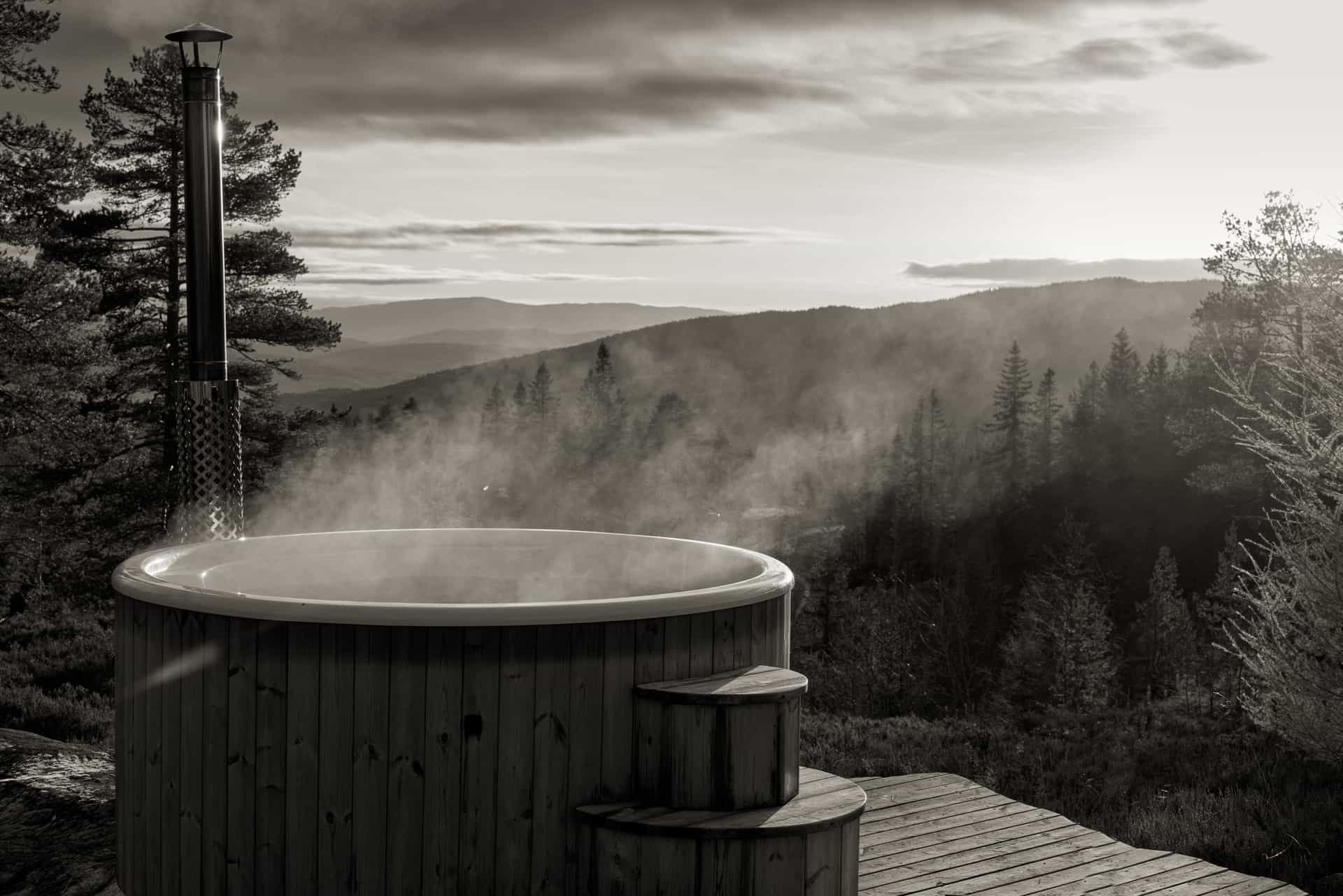
The short verdict: a sauna is less work, cheaper to run and easier to install. A hot tub is more sociable, easier on people who dislike intense heat, and a permanent water-chemistry commitment. If the deciding factor is how much ongoing effort you want, it is not close — the sauna wins.
| Sauna | Hot tub | |
|---|---|---|
| What it is | A heated room | A body of heated water |
| Temperature | 175–195 °F air | ~100–104 °F water |
| Session length | 10–20 min typically | 20–45 min typically |
| Sociability | Quieter, often solitary | Conversational |
| Install | Timber room, 240 V circuit | Pad, 240 V circuit, water supply |
| Running cost | Only when in use | Continuous — it holds temperature 24/7 |
| Ongoing maintenance | Wipe down, air out | Water chemistry, filters, weekly |
| Water use | None | Full drain and refill periodically |
| Freeze risk | Minimal | Real — a frozen tub is expensive |
The running-cost difference is structural
This is the number people get wrong, and it is not close.
A sauna uses power only when you use it. A 6 kW heater for a 45-minute session is 4.5 kWh at the upper bound — roughly $0.77 at $0.17/kWh, and less in practice because the elements cycle once the room is hot. Three sessions a week is a couple of dollars.
A hot tub holds temperature continuously. It heats water to ~102 °F and keeps it there all day, every day, whether or not anyone gets in — because heating several hundred gallons from cold on demand would take many hours. That is a standing load, and it is why hot tub running costs are an order of magnitude conversation rather than a rounding error.
Maintenance is the real decision
A hot tub is a body of warm water that people sit in, which is exactly the condition water chemistry exists to manage. That means, roughly weekly and forever: testing, balancing pH and alkalinity, sanitizer levels, filter cleaning, and periodic full drain-and-refill.
None of it is difficult and all of it is relentless. It is the single most common reason hot tubs fall out of use — not the cost, not the experience, but the fact that neglecting it for three weeks produces a problem you then have to fix.
A sauna asks you to wipe the benches down and leave the door ajar to dry. That is the entire routine, plus checking the stones annually.
Where the hot tub genuinely wins
- Sociability. A hot tub is a place to sit and talk for 40 minutes. A sauna at 190 °F is not a conversational environment in the same way, and sessions are shorter.
- Accessibility of the heat. 102 °F water is tolerable for people who find 190 °F air oppressive or unmanageable.
- Buoyancy. Water takes weight off joints, which is a real and distinct benefit a sauna does not offer.
- Year-round appeal in cold weather. Sitting in hot water in falling snow is a specific pleasure.
Where the sauna wins
- Effort. Not close. Wipe down and air out against weekly water chemistry.
- Running cost. Per-session against continuous.
- Winter resilience. A sauna does not freeze. A hot tub that loses power in a hard freeze is an expensive problem.
- Water. A sauna uses none. A hot tub is several hundred gallons, drained and refilled periodically.
- Install simplicity. No water supply, no drainage.
The contrast therapy angle
If what you want is heat and cold in the same setup, the pairing to consider is not a hot tub — it is a sauna and a cold plunge. That gives you a genuine temperature contrast rather than warm water and slightly less warm water, and a plunge tub is dramatically less maintenance than a hot tub because cold water is a far less hospitable environment for biology.
It is also cheaper to run in a cold climate, where outside air does the chilling for months. See contrast therapy guide and home recovery setup budget.
Which should you buy?
A sauna, if you want the least ongoing commitment, the lowest running cost and the intense heat experience. A hot tub, if the appeal is sitting and talking in warm water and you are genuinely willing to do the chemistry every week for years.
Be honest with yourself about that last part. The maintenance is not hard and it is constant, and the tubs that end up covered and unused are the ones bought by people who thought they would keep up with it.
The sauna-and-plunge alternative
Canadian Red Cedar 1–2 Person Traditional Sauna, 6 kW
MCP Distributions
#ad Price as of October 23, 2026. We earn a commission if you buy, at no extra cost to you. How this is funded.
6 kW into a one-to-two-person room is a lot of heater for the volume, which is exactly why it reaches temperature fast and holds it when you throw water.
| Capacity | 1–2 person |
|---|---|
| Type | Traditional, wet or dry |
| Wood | Canadian red cedar |
| Heater | 6 kW, rocks included |
| Rated maximum | 200 °F |
| Circuit | 240 V |
| Control | Heater-mounted |
What works
- Heater is generously sized for the cabin volume — fast recovery after a water throw
- Cedar interior at a small-cabin price
- Rocks included, which is not universal
What doesn't
- 240 V circuit required
- An oversized heater wastes energy if you only ever run short sessions
- 'One to two person' means one person plus a towel
Skip it ifyou run 20-minute sessions and care about the power bill. A 6 kW heater in a small room spends much of its cycle at full draw — a 4.5 kW would cost you less per session.
Ice Barrel 300 Cold Plunge Tub
Ice Barrel
#ad Price as of October 23, 2026. We earn a commission if you buy, at no extra cost to you. How this is funded.
Rigid rather than inflatable, and insulated rather than bare — the two properties that decide whether ice lasts an afternoon or a morning.
| Volume | 77 gallons |
|---|---|
| Construction | Rigid, fully insulated |
| Orientation | Upright, seated |
| Chiller compatible | Yes |
| Footprint | Barrel — the smallest floor area here |
| Wall thickness | Not published |
| Availability when checked | Buy box live and in stock, re-checked 2026-09-10 |
What works
- Insulation holds temperature between sessions, cutting ice use and chiller runtime
- Rigid walls need no re-inflating and no babysitting
- The smallest floor footprint of any tub on this list
What doesn't
- Upright seating only — no lying down, no leg extension
- 77 gallons is not much water above the shoulders for a tall person
- Rigid means bulky to store and impossible to move alone
Skip it ifyou are over about 6'2". An upright barrel puts tall shoulders above the waterline and there is no adjusting for it.
Specs above are the manufacturer's published figures — source.
AS ColdPlunge 1/3 HP Chiller, Built-In Filter and Pump
AS ColdPlunge
#ad Price as of October 23, 2026. We earn a commission if you buy, at no extra cost to you. How this is funded.
The integrated pump and filter is the reason to pick this one: an external-pump chiller needs three more purchases and four more hose connections to reach the same place.
| Cooling capacity | 1/3 HP |
|---|---|
| Minimum temperature | 42 °F |
| Pump | Built in, submersible |
| Filtration | Built in |
| Hoses | Insulated, included |
| Duty cycle | Rated for 24/7 operation |
| Fits | Cold plunge tubs and bathtubs |
| Pull-down time | Not published |
What works
- Pump and filter integrated — one box, one plug, no shopping list
- A 42 °F floor is cold enough for any protocol worth running
- Insulated hoses included rather than sold as an upgrade
What doesn't
- 1/3 HP is slow to pull a large tub down from ambient
- The 42 °F floor is warmer than the 37–39 °F the 1 HP units claim
- No published pull-down time, so sizing is arithmetic you do yourself
Skip it ifyour tub is over roughly 100 gallons or lives outdoors in a hot climate. At 1/3 HP you will be waiting overnight for a pull-down a 1/2 HP does in an afternoon.
Questions people actually ask
Is a sauna or hot tub cheaper to run?
Which is more maintenance, a sauna or a hot tub?
Should I get a sauna or a hot tub?
Can you have both a sauna and a hot tub?
Do hot tubs need to be left on all the time?
Sources
- US Energy Information Administration — average retail electricity prices used in the sauna cost figure — checked Sep 7, 2026
- Harvia — sauna heater specifications used in the running-cost arithmetic — checked Sep 7, 2026
Read next
- Contrast therapy guideThe pairing that actually makes sense.Read it
- Sauna running costsThe side we can calculate.Read it
- Home recovery setup budgetWhat a full setup costs.Read it
- Best cold plunge tubsThe cold half of the alternative.Read it
- Cold plunge vs hot tubThe cold-water version.Read it
- Sauna vs cold plungeThe other side-by-side.Read it
Every pick on this page comes from published specifications, not from hardware we own. Read how we pick — including what spec-led ranking cannot tell you.