Adding red light to an existing sauna
Retrofitting tubes into a cabin's wiring is not realistically available. A standalone panel is — with one specification caveat that decides how you use it.
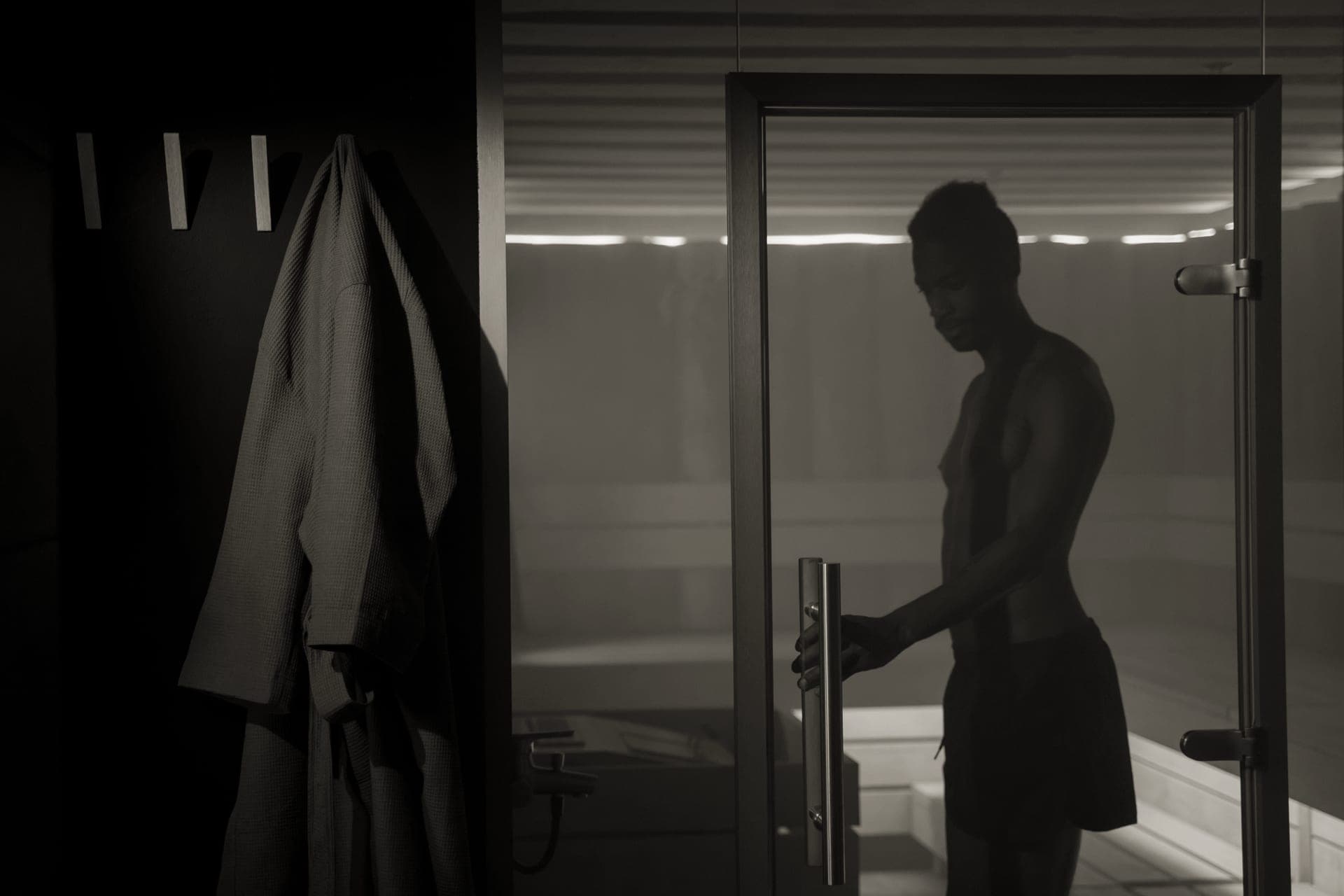
You own an infrared cabin. It is far infrared, and you want the near-infrared and red wavelengths a full-spectrum cabin offers. The question is what is actually achievable without replacing the cabin.
What is not realistically available
Retrofitting tubes into the cabin's own wiring. Cabins are built as sealed units with the emitters wired to a controller sized for those emitters. Adding load to that circuit is not a consumer modification, manufacturers do not sell retrofit kits for their own cabins as a general rule, and doing it yourself means modifying a mains-powered appliance in a humid, hot enclosure.
So the practical answer is a standalone panel, and the useful question becomes how to use one with a sauna you already have.
The temperature caveat
The approach we would take
Use the panel outside the cabin, before or after the session. It costs a few minutes, it removes the temperature question entirely, and it gives you something the built-in version cannot: control over the distance between the emitter and your skin, which is what determines dose.
Practically, that looks like: panel session in the room outside the sauna, then the sauna. Or the reverse. Neither order has a research basis we would cite — this is a practical arrangement, not a protocol.
Choosing the panel
- 1Board area for the use you have. A narrow board suits targeted work — a back, a shoulder. A full-body board means one position and one timer.
- 2Dual chip 660/850 nm. Both wavelengths from every diode, which means even coverage rather than striping.
- 3Mounting that suits the space. A door hook, a wall mount or a stand. Check what is included, because listings often do not say.
- 4Ask for the irradiance figure and distance. Nobody publishes it, but asking costs nothing and how a company responds is informative. See irradiance explained.
Panels that suit a retrofit
Supersred Red Light Therapy Panel, 1,500 W Dual-Chip Board
Supersred
#ad Price as of October 23, 2026. We earn a commission if you buy, at no extra cost to you. How this is funded.
Dual-chip diodes, so both wavelengths come from every LED rather than alternating across the board. The listing publishes a wattage and the wavelengths and nothing else — no board size, no irradiance.
| Power, per the listing | 1,500 W lamp board |
|---|---|
| Wavelengths | 660 nm and 850 nm, dual chip |
| Board size | Not published in the listing |
| LED count | Not published in the listing |
| EMF | Not published |
| Irradiance | Not published at a stated distance |
What works
- Dual-chip LEDs, so coverage is even rather than striped
- A stated wattage, which most panels at this price omit
- Both research-backed wavelengths in one board
What doesn't
- No published board dimensions, so coverage cannot be checked before it arrives
- No irradiance figure at any distance
- A lamp wattage is not the same as delivered output
Skip it ifyou need to know the treated area before buying. This listing will not tell you how big the board is.
Full-Body Red Light Therapy Panel, 5 Wavelengths, 120 Dual-Chip LEDs
Generic Amazon listing
#ad Price as of October 23, 2026. We earn a commission if you buy, at no extra cost to you. How this is funded.
Five wavelengths across 120 dual-chip diodes, with a published wattage. Dual chip means every LED emits more than one wavelength, so coverage is even rather than striped.
| LEDs | 120, dual chip |
|---|---|
| Wavelengths | 5, per the listing |
| Power | 200 W |
| Board size | Not published in the listing |
| Stand | Not published in the listing |
| Irradiance | Not published at a stated distance |
What works
- A published wattage and LED count
- Dual-chip diodes, so both main wavelengths come from every LED
- More wavelengths than the two-wavelength boards at this size
What doesn't
- No published board dimensions
- No irradiance figure at any distance
- Extra wavelengths have a thinner research base than 660 and 850 nm
Skip it ifyou want the largest treated area per dollar. Wavelength count is not coverage.
EXESAS Red Light Therapy Device, 400 W, 80 LED
EXESAS
#ad Price as of October 23, 2026. We earn a commission if you buy, at no extra cost to you. How this is funded.
Fewer, higher-output diodes rather than many small ones — a different design philosophy that concentrates output at the cost of even coverage.
| Rated power | 400 W (LED rating) |
|---|---|
| LEDs | 80, dual chip |
| Wavelengths | 660 nm and 850 nm |
| Use | Full body and face |
| Irradiance | Not published at a stated distance |
| Wall draw | Not published |
What works
- 5 W per diode is genuinely high output per LED
- Both wavelengths in each diode
- Sized for face work as well as body
What doesn't
- Fewer diodes means more visible hot-spotting at close range
- Rated wattage is not measured wall draw
- No irradiance figure
Skip it ifyou want even coverage up close. Fewer, brighter diodes hot-spot; more, dimmer diodes do not.
If you genuinely want it inside the cabin
Two conditions, both non-negotiable. First, get an operating temperature range from the manufacturer in writing and confirm your cabin's operating temperature is inside it. Second, be aware that the cabin's humidity is part of the question too — a dry infrared cabin is a different environment from a traditional sauna where you throw water, and no consumer panel is built for the latter.
If both conditions are met, mount it where it is not in contact with a heater panel and where the distance to your body is what you want. If either condition is not met, use it outside the cabin. There is no version of this where guessing is the right approach.
The alternative: accept the cabin is what it is
A perfectly reasonable outcome. A far-infrared cabin is a good product doing the thing it was built for. Adding a panel is an addition rather than a correction, and if you use the cabin regularly and are happy with it, the honest answer may be that you do not need to add anything.
If you are unsatisfied with the cabin itself — too small, not hot enough — that is a different problem and a panel does not solve it. See infrared sauna upgrade kits for what is and is not fixable.
What about replacing the cabin?
Worth pricing properly before deciding. A full-spectrum cabin typically draws around 3,600 W and needs 220 V — an electrician, a permit in most jurisdictions, and a real install cost on top of the cabin. A far-infrared cabin you already own plus a panel on a normal outlet avoids all of that.
Unless there is something else wrong with your current cabin, replacing a working far-infrared cabin to get built-in tubes is an expensive way to obtain wavelengths a panel delivers with more control. See full spectrum vs far infrared.
Questions people actually ask
Can you add red light therapy to an existing infrared sauna?
Can you put a red light panel inside a sauna?
Is it worth replacing a far infrared sauna with a full spectrum one?
Should I use red light before or after a sauna?
Sources
Read next
Every pick on this page comes from published specifications, not from hardware we own. Read how we pick — including what spec-led ranking cannot tell you.