Barrel vs cube sauna
The barrel's curve is a thermal decision that happens to look distinctive. Here is what each shape actually costs and buys, and which one your yard and your patience suit.
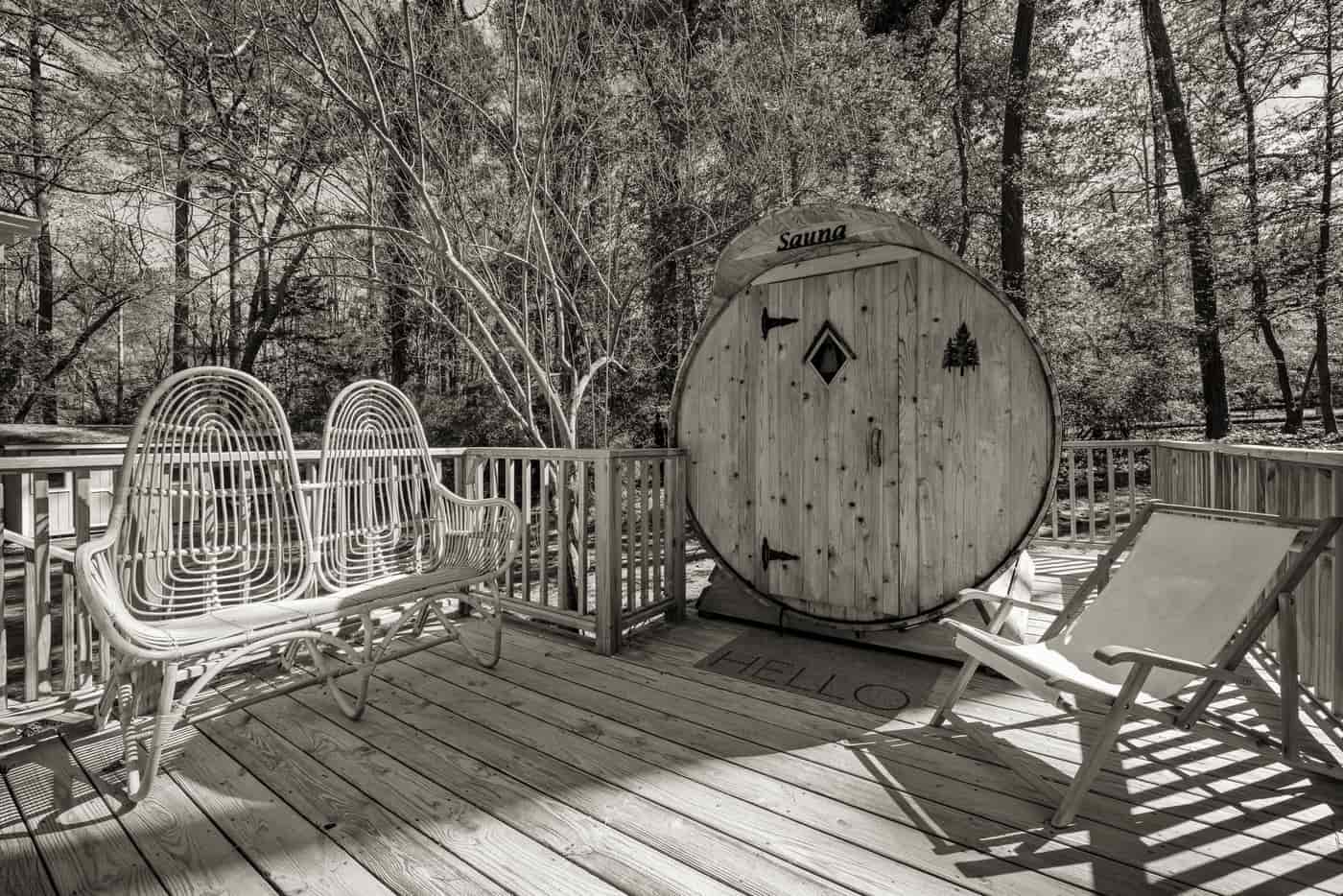
The short verdict: a barrel heats faster and costs less; a cube gives you usable space and looks like a building rather than a tank. If warm-up speed and budget lead, buy the barrel. If the sauna has to look like it belongs in your garden and you want headroom at the walls, buy the cube.
| Barrel | Cube | |
|---|---|---|
| Air volume above head height | Less — the curve removes it | More |
| Warm-up speed for the same heater | Faster | Slower |
| Usable headroom at the walls | Limited by the curve | Full |
| Shipping cost | Lower — staves pack flat | Higher |
| Purchase price | Generally lower | Generally higher |
| Roof risk | High — water sits where the curve flattens | Lower — a conventional roof |
| Roof covering published? | Rarely | More often |
| Looks like | Equipment | A garden building |
| Resale appeal | Narrower | Broader |
Why the curve makes a barrel heat faster
Heat rises. In a rectangular room, the air above your head is heated along with everything else and does nothing for you — it is volume the heater has to warm and you never use. A barrel's curve removes a good deal of that volume, so a given heater is warming less air to get the space you actually occupy up to temperature.
It is a genuine, physical advantage rather than a marketing point, and it is why barrels reached their popularity. The same curve is what takes your headroom at the walls, so you cannot have one without the other.
Why the roof is the barrel's weak point
At the crown of a barrel the curve flattens, and water sits there rather than running off. Over years of freeze-thaw that is where rot starts. A conventional pitched or flat roof on a cube sheds water by design.
This is fixable and cheap — asphalt shingles or a membrane over the top arc, a modest material cost and an afternoon — but most barrel listings do not say whether one is included, so you have to check and probably budget for it. In our survey, cube listings were noticeably more likely to publish a roof specification.
Choose the barrel if...
- Warm-up time matters to you. The thermal advantage is real and you feel it on every session.
- Budget is the binding constraint. Barrels cost less to buy and less to ship.
- You are comfortable adding a roof covering and treating it as part of the purchase.
- You mostly sit. The curve costs you nothing if you are not standing up.
Choose the cube if...
- The sauna has to look right in the garden. A cube reads as architecture; a barrel reads as equipment. This is not a trivial consideration for something permanently in view.
- You want headroom at the walls, to stand, change or use a full-height upper bench.
- You want a specified roof rather than a question mark.
- You want a wood-fired option in this format — the Smartmak cube removes the electrical run entirely.
What is the same either way
Wood species matters equally — cedar outdoors, whatever the shape. Heater sizing against room volume is identical arithmetic. The foundation requirement is the same: level, drained, and below the frost line in a freeze-thaw climate. And in both cases the delivery is curbside freight, so several hundred pounds of timber gets from the street to the yard under your own power.
In other words, most of what determines whether you are happy in five years is not the shape. It is the wood, the heater, the roof and the base.
A barrel and a cube worth comparing
INFRADELUX 4-Person Outdoor Barrel Sauna, Japanese Cedar, 6 kW Harvia
INFRADELUX
#ad Price as of October 23, 2026. We earn a commission if you buy, at no extra cost to you. How this is funded.
A named Harvia heater, four-person capacity and a published roof covering — on this site's own order of priority, the heater comes first and the roof third, and this is the only barrel in stock that publishes both. The wood is Japanese cedar rather than the western red cedar we would otherwise argue for.
| Capacity | 4 person |
|---|---|
| Dimensions | 72 × 65 × 79 in (listing also gives 65 × 79 × 73 in) |
| Wood | Japanese cedar, per the listing |
| Heater | 6 kW Harvia |
| Type | Traditional barrel |
| Roof covering | Waterproof asphalt shingle roof, stated |
| Structure | Stated 1,000 lb load capacity |
| Circuit | 240 V — required for a 6 kW heater |
| Included | Sauna accessory set; stones NOT included, per the listing |
| Warranty | Personal use only — commercial or rental use is excluded |
What works
- A Harvia heater means a published spec sheet, a rated room volume and a real parts channel
- Publishes a roof covering and a structural load rating, which barrels rarely do
- 6 kW is properly sized for a four-person barrel volume
What doesn't
- Japanese cedar, not western red cedar — a named species, but not the one this site argues for outdoors
- Sauna stones are not included, so budget for a load of them
- A 240 V run to the yard is a real, permitted expense, and delivery is a curbside freight drop
Skip it ifyour yard has no realistic path for a 240 V run. Trenching a circuit to the back of a garden regularly costs more than the sauna, and it is not a corner worth cutting.
Smartmak Outdoor Square Sauna, 6–8 Person, Wood-Burning
Smartmak
#ad Price as of October 23, 2026. We earn a commission if you buy, at no extra cost to you. How this is funded.
A cube shape and a wood stove together mean no trench, no permit and no electrician — the install cost that sinks most outdoor sauna projects simply is not there.
| Capacity | 6–8 person |
|---|---|
| Shape | Square / cube |
| Wood | Hemlock |
| Heater | Wood-burning stove |
| Roof | Waterproof asphalt shingles |
| Power required | None for the stove |
| Accessories | Included |
What works
- Wood fired means zero electrical infrastructure
- An asphalt shingle roof is actually specified, which barrels rarely are
- Cube geometry uses interior volume better than a barrel at the same footprint
What doesn't
- Hemlock outdoors is a worse choice than cedar over a decade
- Wood firing means a 45-minute lead time and ash management every session
- A chimney through a roof needs correct clearances
Skip it ifyou want heat on a schedule. Wood-fired saunas reward planning and punish spontaneity.
ZONEMEL Outdoor Barrel Sauna, 3–4 Person, 4.5 kW ETL
ZONEMEL
#ad Price as of October 23, 2026. We earn a commission if you buy, at no extra cost to you. How this is funded.
4.5 kW into a three-to-four person barrel is the sweet spot almost nobody points at: properly sized for the volume, on the smallest circuit that will do the job.
| Capacity | 3–4 person |
|---|---|
| Wood | Spruce |
| Heater | 4.5 kW, ETL certified |
| Stones | Volcanic stones, included |
| Door | Tempered glass |
| Included | Wooden buckets and ladle |
| Circuit | Not published in the listing |
What works
- Heater is matched to the cabin volume rather than over-specified
- A smaller heater than a 6 kW unit, which lowers the install bill
- ETL-certified heater, with stones and the bucket set in the box
What doesn't
- 'Three to four person' means three adults, realistically
- Spruce rather than cedar, so expect more upkeep outdoors
- The listing does not publish the circuit, so have an electrician size it
Skip it ifyou want a genuinely hot barrel in a cold climate. In sub-freezing ambient temperatures 4.5 kW struggles, and you should step up to 6 kW or more.
Questions people actually ask
Do barrel saunas heat up faster than cube saunas?
Are cube saunas worth the extra money?
Which lasts longer, a barrel or a cube sauna?
Can you stand up in a barrel sauna?
Sources
- Amazon.com — barrel and cube sauna listings, dimensions and roof specifications as published by the sellers — checked Sep 7, 2026
- Harvia — heater specifications and rated room volumes — checked Sep 7, 2026
Read next
Every pick on this page comes from published specifications, not from hardware we own. Read how we pick — including what spec-led ranking cannot tell you.