Barrel sauna upgrades worth making
Most barrels ship missing two or three things that materially change how they perform and how long they last. Here is what to add, in the order that matters.
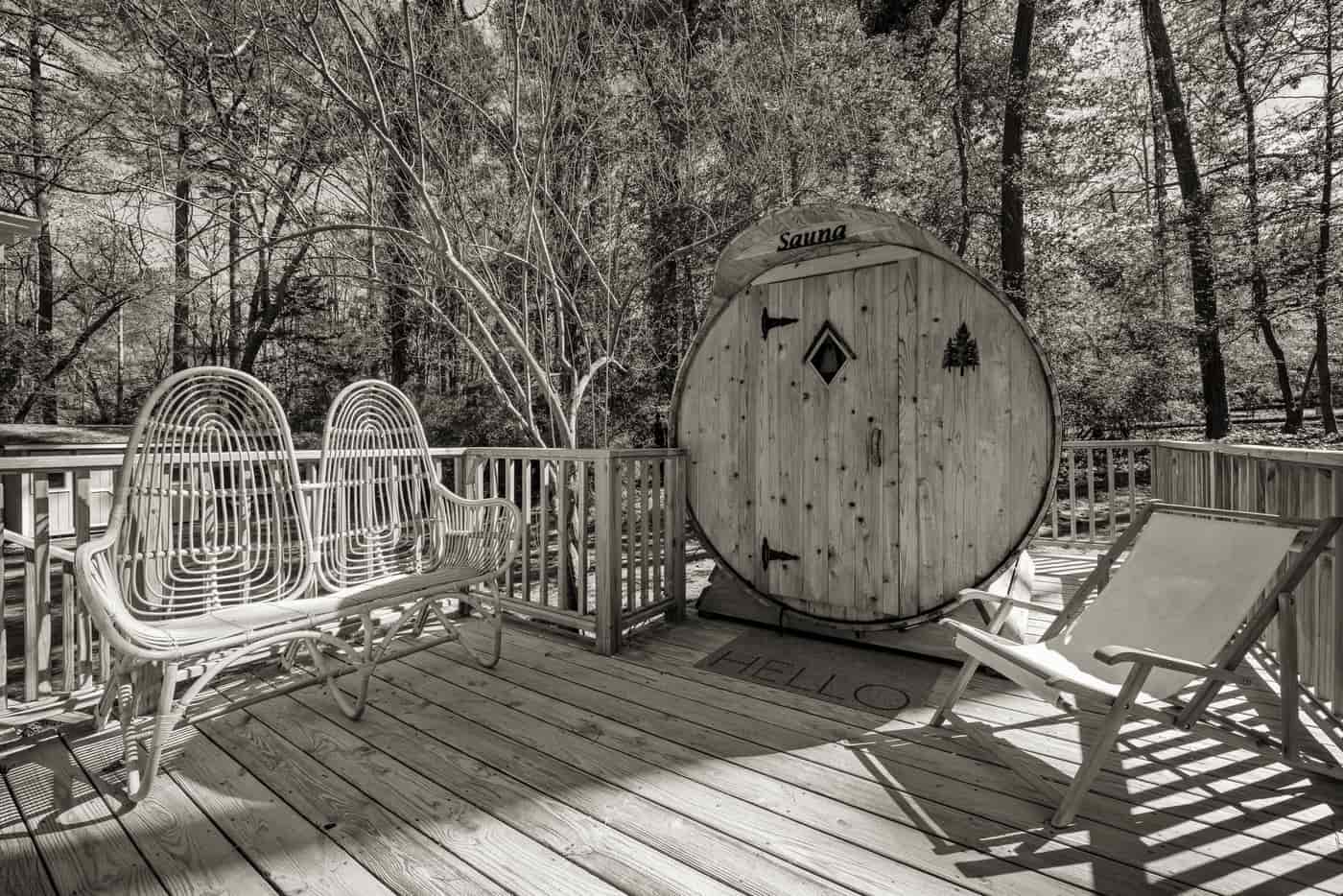
A barrel sauna is a good product that ships slightly incomplete. Most of what is missing is cheap, and one item is genuinely important — if you do nothing else on this page, do the first one.
1. A roof covering (do this first)
Barrels rot at the crown, where the curve flattens and water sits rather than running off. Most barrel listings do not say whether a covering is included, which in practice means it is not.
Asphalt shingles or a rubber membrane over the top arc is a modest material cost and an afternoon of work, and it is the single largest determinant of whether the structure is sound in year eight. It is not an upgrade so much as a completion of the purchase. Do it in the first month, not the third winter.
2. Tighten the bands, and keep tightening them
3. The heater, if yours is unbranded
This is the expensive upgrade and it is worth considering only in one circumstance: your barrel came with an unbranded element and that element has failed or is failing. At that point you are hunting for a replacement anyway, and stepping to a named heater with a published rated room volume and a real parts channel means you never have this problem again.
Match the output to your barrel's volume rather than to whatever was in there — the original may have been undersized. Harvia's 6 kW models are rated for 177–283 cubic feet, which covers most four-person barrels. See the heater sizing guide.
Do not replace a working heater for a marginal gain. Swapping an element is electrical work on a 240 V circuit and it is not a casual afternoon.
4. The comfort items, which cost almost nothing
- 1A backrest. A barrel's curved wall is not a bad backrest by accident — it is not a backrest at all. A contoured backrest is the difference between a 20-minute session and a 40-minute one.
- 2A seat pad. Hot cedar against bare skin, particularly on a rustic-grade bench with knots in it, is genuinely unpleasant. A felt pad solves it for pennies.
- 3A bucket with a removable liner. Bare wooden buckets dry out, shrink and leak. Lined ones do not. And in a traditional barrel you actually need one, because you can throw water.
- 4A battery-free gauge. Knowing the temperature turns a vague session into a repeatable one. Battery-free because anything with a cell in it eventually fails in a 190 °F room.
- 5A wool hat. At 190 °F your scalp and ears become uncomfortable well before the rest of you. 100% wool, not a blend — blends melt.
Upgrades worth the money
Harvia Topclass 6 kW Electric Sauna Heater
Harvia
#ad We earn a commission if you buy, at no extra cost to you. How this is funded.
Harvia publishes the room volume each heater is rated for. That single number solves the entire heater-selection problem, and most brands will not give it to you.
| Output | 6 kW |
|---|---|
| Rated room volume | 177–283 cubic feet |
| Voltage | 240 V, single phase |
| Control | Integrated panel, mountable either side |
| Stones | Included |
| Type | Wall-mounted electric |
What works
- Rated room volume published as a range — the spec that decides the purchase
- Control panel can go on either side, which matters in a tight room
- Harvia elements and parts are genuinely available years later
What doesn't
- Requires a dedicated 240 V circuit
- Included stones are the basic grade and many owners upgrade them
- The volume rating assumes an insulated room; an uninsulated one needs more heater
Skip it ifyour room is over 283 cubic feet. Undersizing a heater is the most common and most expensive sauna mistake — step up to the 8 kW.
Specs above are the manufacturer's published figures — source.
DUNUO Red Cedar Sauna Bucket, Ladle and Gauge Set
DUNUO
#ad Price as of October 23, 2026. We earn a commission if you buy, at no extra cost to you. How this is funded.
The removable liner is the detail that matters. Bare wooden buckets dry out, shrink and leak; a lined one does not.
| Contents | Bucket, ladle, thermometer/hygrometer |
|---|---|
| Bucket volume | 1 gallon (4 L) |
| Liner | Removable |
| Wood | Red cedar |
| Gauge | °F/°C dual scale, battery free |
| Mounting | Wall-mounted gauge |
What works
- The removable liner solves the leaking-bucket problem permanently
- Battery-free gauge — nothing to replace inside a 190 °F room
- Dual scale, so imported manuals still make sense
What doesn't
- Three pieces means three things to store
- Cedar needs occasional oiling to stay presentable
- Combined thermo-hygrometers are less accurate than separate instruments
Skip it ifyou run a dry infrared cabin. There is no water throwing in an infrared sauna, which makes a bucket and ladle purely decorative.
Red Cedar Sauna Thermometer and Hygrometer, Wall Mount
DUNUO
#ad We earn a commission if you buy, at no extra cost to you. How this is funded.
Battery free is non-negotiable in a room that reaches 190 °F. Anything with a cell in it will fail, and will probably leak while doing so.
| Type | Combined thermometer and hygrometer |
|---|---|
| Scale | °F and °C |
| Power | None — mechanical |
| Mounting | Wall |
| Material | Red cedar surround |
| Stated accuracy | Not published |
What works
- No battery to cook, leak or replace
- Dual scale removes unit confusion with imported heaters
- Reads humidity as well as temperature
What doesn't
- No published accuracy tolerance
- Combined gauges are less accurate than separate instruments
- Hygrometers drift and cannot easily be recalibrated
Skip it ifyou need accuracy rather than indication. Analog sauna gauges are directional instruments; if you need a real number you need a lab thermometer.
Halsa 100% Wool Sauna Hat
Halsa
#ad Price as of October 23, 2026. We earn a commission if you buy, at no extra cost to you. How this is funded.
100% wool, stated plainly. Blends with synthetic content melt and stink at sauna temperatures, and most listings will not tell you the fiber content at all.
| Material | 100% wool |
|---|---|
| Style | Bucket, Finnish banya |
| Function | Hair and scalp heat protection |
| Use | Traditional and infrared saunas |
| Sizing | Not published |
| Care | Not published |
What works
- Fiber content published as 100% wool with no blend
- The bucket shape covers the ears, which is where heat hurts first
- Wool naturally resists odor between washes
What doesn't
- No published sizing, and wool felt hats are not adjustable
- Care instructions not published; felt shrinks in a machine
- Looks eccentric if you are not expecting it
Skip it ifyou run an infrared cabin at 130 °F. A hat is a solution to 190 °F air, and infrared cabins never get there.
5. Lighting, done correctly
Sauna lighting must be rated for the temperature and humidity, and it must be installed with the fitting outside the hottest zone. This is not a place for a standard fixture — a domestic fitting in a sauna is a genuine hazard rather than a shortcut. Use a fixture specified for sauna use and follow its stated installation position.
6. Ventilation, if yours is inadequate
A sauna needs an air inlet low near the heater and an outlet high on the opposite wall. Many budget barrels ship with token ventilation or none. Poor ventilation makes the room feel stuffy well before it is actually too hot, and it slows drying afterwards, which is a longevity issue as much as a comfort one.
Adding a vent is straightforward on a stave-built barrel, but it is a hole in your sauna — measure carefully and follow the heater manual's guidance on inlet position relative to the stove.
What not to bother with
- Interior sealing or varnish. Never. Sauna interiors stay bare so the timber can breathe; sealed wood traps moisture and gets unpleasantly hot to touch.
- Bluetooth speakers. Electronics in a 190 °F humid room have a short and unhappy life.
- Color-changing lighting. It is a feature that adds a failure point in a hostile environment.
- Upgrading rustic timber to clear. Not economically sensible after the fact — that decision was made at purchase.
Questions people actually ask
Do barrel saunas need a roof?
How often should barrel sauna bands be tightened?
Can you replace the heater in a barrel sauna?
What is the best upgrade for a barrel sauna?
Should you seal or varnish a barrel sauna?
Sources
- Harvia — heater specifications and rated room volumes for the replacement sizing — checked Sep 7, 2026
- Amazon.com — sauna accessory listings, specifications as published by the sellers — checked Sep 7, 2026
Read next
- Best sauna accessoriesThe comfort items, ranked.Read it
- Sauna heater sizing guideBefore you replace an element.Read it
- Outdoor sauna winter maintenanceThe seasonal routine, including bands.Read it
- Best barrel saunasIf you have not bought one yet.Read it
- Best barrel saunas with a porchOr buy one with a porch.Read it
- Best sauna lightsCuttable strip for a curved wall.Read it
- Best sauna backrestsFitting one to a curved wall.Read it
Every pick on this page comes from published specifications, not from hardware we own. Read how we pick — including what spec-led ranking cannot tell you.